
The Numbers, First Impressions
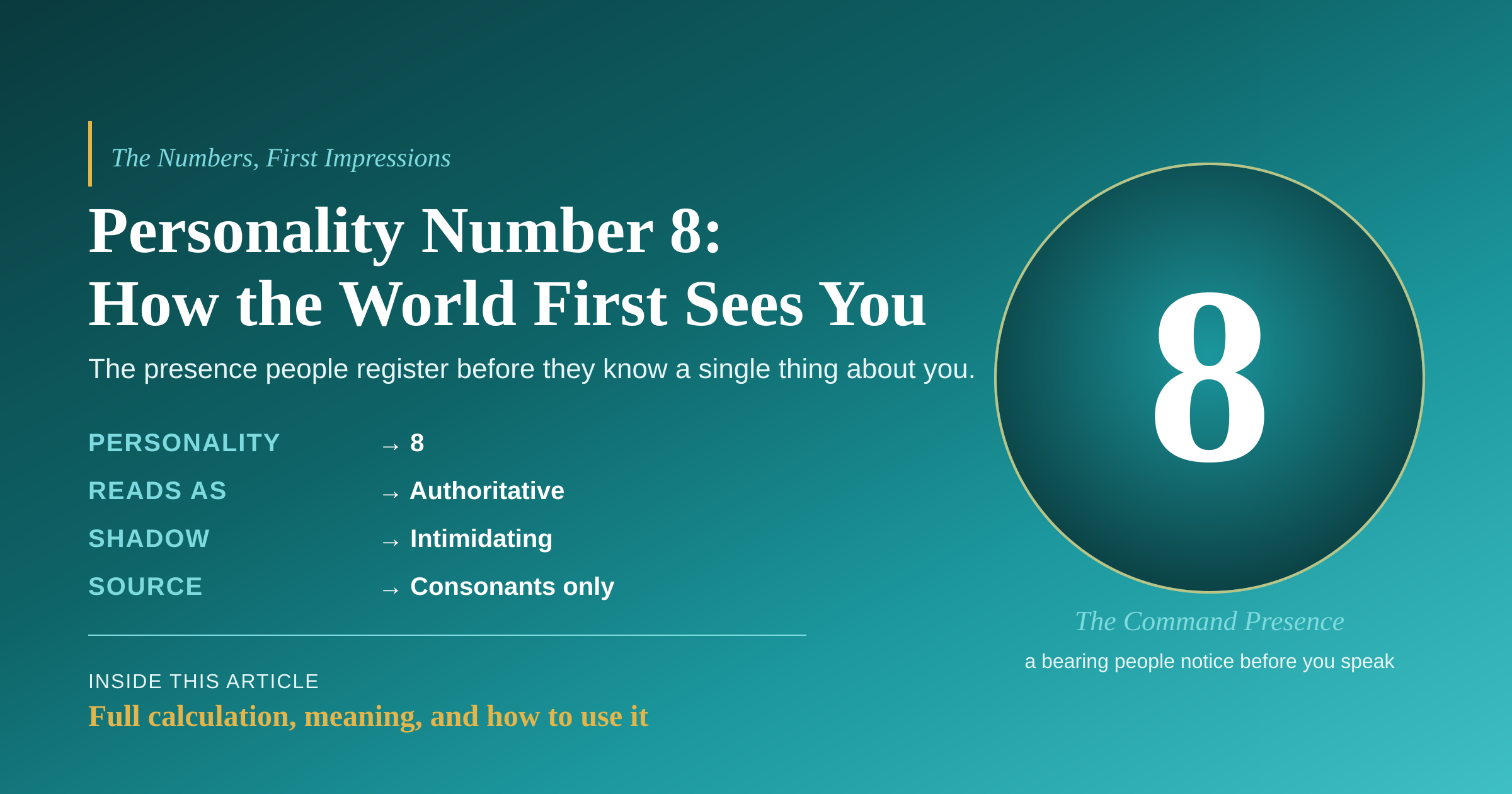
Personality Number 8: How the World First Sees You
Before anyone reads your resume or hears your story, they read your presence. This is the number behind that first read.
You walk into a room and something happens before you've said a word. People adjust. They straighten up a little, wait to see where you'll sit, assume you're the one who makes the call. If that sounds familiar, your name is very likely carrying a Personality Number of 8 — the number Western numerology assigns to a bearing that reads as command, competence, and quiet authority on contact.
Quick answer
Personality Number 8 means people register you, on first meeting, as capable and in charge — someone who seems built for responsibility even before you've demonstrated it. The shadow side is that this same presence can read as intimidating or status-obsessed before anyone has seen what's actually behind it.
This number has nothing to do with confidence you feel on the inside, and nothing to do with your birth date. It comes from your name — specifically, from the consonants in your name, which is why two people who seem nothing alike in temperament can carry the exact same Personality Number. It's a surface reading, not a verdict on your character. Numerology at its best works like a map for decisions, not a fortune — it tells you what terrain you're standing on, not where you have to end up.
What the Personality Number actually is
In the Pythagorean tradition of numerology — the branch this site works from, following the Decoz and Javane-Bunker lineage — your full birth name yields several different numbers, each drawn from a different slice of the letters. Your Life Path comes from your birth date. Your Destiny (or Expression) Number comes from every letter in your name. Your Soul Urge comes from the vowels alone, describing what actually drives you underneath. And your Personality Number comes from the consonants alone — the letters left over once every vowel sound is removed.
That split isn't arbitrary. In this tradition, vowels are treated as the sound of inner motivation — what you want. Consonants are treated as structure and shape — what people can immediately observe. Strip the vowels from a name and what's left is, in a sense, its skeleton: the part visible from across the room, before anyone gets close enough to hear what you actually want. If you haven't run your own numbers yet, the numerology tools will calculate all four core numbers from the same name and birth date in one pass.
Why this number matters
Most people spend energy managing a gap between how they intend to come across and how they're actually received. Your Personality Number names that gap directly. If you're an 8, you may already sense that people default to treating you as the person in charge — asking you to decide, assuming you have the answer, occasionally hanging back around you without you doing anything to invite it. Knowing that this is baked into your name's structure, rather than something you're unconsciously performing, changes how you can work with it. You stop wondering why people keep handing you the reins, and you start deciding what to do with that authority once it's handed to you. Pair it with your Life Path from the free calculators to see the full picture rather than just the surface.
How it's calculated — full worked example
The method uses the standard Pythagorean letter-value chart, where every letter maps to a digit 1 through 9:
| Value | Letters |
|---|---|
| 1 | A, J, S |
| 2 | B, K, T |
| 3 | C, L, U |
| 4 | D, M, V |
| 5 | E, N, W |
| 6 | F, O, X |
| 7 | G, P, Y |
| 8 | H, Q, Z |
| 9 | I, R |
Vowels — A, E, I, O, U — are always excluded. Y is excluded when it's making a vowel sound in that particular name, and included when it's acting as a consonant. The rule is to work name part by name part: pull the consonants from the first name, convert and sum them, and reduce that sum to a single digit unless it lands on a Master Number (11, 22, or 33). Repeat separately for the middle name, then the last name. Add the three already-reduced totals, then reduce that final combined sum to a single digit — again, unless it's itself 11, 22, or 33.
Example — Apple co-founder Steven Paul Jobs offers a clean, well-documented case, with no ambiguous Y or W sounds to argue over.
STEVEN — consonants S, T, V, N → S=1, T=2, V=4, N=5 → 1+2+4+5 = 12 → 1+2 = 3
PAUL — consonants P, L → P=7, L=3 → 7+3 = 10 → 1+0 = 1
JOBS — consonants J, B, S → J=1, B=2, S=1 → 1+2+1 = 4
Final total: 3 + 1 + 4 = 8 — already a single digit, and not a Master Number, so the calculation stops here.
Every step is transparent: no vowel was miscounted, no Y or W required a judgment call, and the arithmetic reduces cleanly to 8 at every stage. That's what makes this name useful as a teaching example — you can check the work yourself in under a minute.
Run your own full name through the calculator instead of doing it by hand.
Open the Numerology ToolsWhat Personality Number 8 means day to day
People with this number tend to be read, almost instantly, as someone who has things handled. It's not that you perform authority — it's that your presence carries a kind of gravity, a sense that you've already been in charge of something before, whether or not that's technically true yet. Strangers ask you for directions in a crowd. Colleagues defer to your read on a room. New acquaintances assume, often correctly, that you're the one holding responsibility somewhere in your life.
The gift in this is real and useful. People trust you with weight quickly, which means doors to leadership, negotiation, and high-stakes decision-making open faster for you than for most. You rarely have to prove you can handle pressure — people extend that credit up front. If you want to see how this number interacts with your Destiny Number, the calculator suite lays both out side by side.
The shadow is just as real. That same bearing can register as cold, materialistic, or intimidating before anyone has actually spoken with you. People might assume you care more about status and success than you do, or hesitate to approach you casually, assuming you're too busy or too important for small talk. If you've ever felt like people decided who you were before you got a chance to show them, this is very often the reason. It isn't a flaw to fix — it's friction worth naming, so you can soften an entrance deliberately when the room calls for warmth rather than command.
Putting Personality Number 8 to use
The most practical use of this number is timing. When you need people to trust your judgment fast — pitching, negotiating, leading a first meeting — your natural presentation is already doing half the work. Lean into it rather than undercutting it with false modesty, which tends to read as incongruent on an 8.
When the goal is connection rather than command — a first date, a grieving friend, a new team you want to feel safe rather than managed — it helps to consciously add warmth: ask more questions than you answer, sit rather than stand, let a silence sit instead of filling it with a decision. None of this changes your Personality Number. It just tells you when to let the natural read work for you and when to intentionally counterbalance it.
It's worth cross-referencing this number against your Life Path and Destiny numbers using the full numerology tools, since an 8 personality paired with a very different Life Path can create real internal tension — looking commanding while feeling, underneath, much less certain. That gap is common and worth understanding rather than ignoring.
Frequently asked questions
What is a Personality Number in numerology?
The Personality Number is calculated from the consonants only in your full birth name. It describes the outer impression you make on people before they know you well — your surface presentation rather than your inner drives. You can calculate yours with the numerology tools.
How do you calculate Personality Number 8?
Take the consonants of your first name, convert each to its Pythagorean value, sum and reduce them. Do the same separately for your middle name and last name. Add the three reduced totals and reduce that final sum to a single digit, unless it lands on 11, 22, or 33.
Why do only consonants count in the Personality Number?
Western numerology treats vowels as the sounds tied to inner motivation, which is why they build the Soul Urge Number instead. Consonants are treated as the shape and structure of a name, which is why they build the outer, first-impression number.
Is Personality Number 8 a good or bad number?
Neither. It describes a first impression, not a verdict. Personality Number 8 tends to read as capable and authoritative, with a shadow side of seeming intimidating or overly focused on status before people know you.
Does a nickname change my Personality Number?
Standard practice uses your full name as recorded at birth, not a nickname or married name, because the calculation is meant to capture the original imprint of the name you were given.
What is the difference between Personality Number and Life Path Number?
Life Path comes from your birth date and describes the terrain of your life's lessons. Personality Number comes from the consonants in your name and describes how you come across before anyone knows your story. Read more in this companion piece on Life Path basics.
Can I have Personality Number 8 and a different Life Path Number?
Yes. Personality Number and Life Path Number are calculated from entirely different inputs — name versus birth date — so they very often differ, and the interplay between them is part of what makes a chart specific to you. See our guide to reading your full numerology chart for how the pieces fit together.
Takeaway: Personality Number 8 means people read you as already in charge before you've proven anything — a genuine asset when you need trust fast, and a gap worth closing deliberately when what the moment actually calls for is warmth.
If this resonates and you want the full system in one place, the book Sort Your Life by the Numbers: A practical introduction to the art of numbers walks through it step by step.