
Personality Numbers, Explained
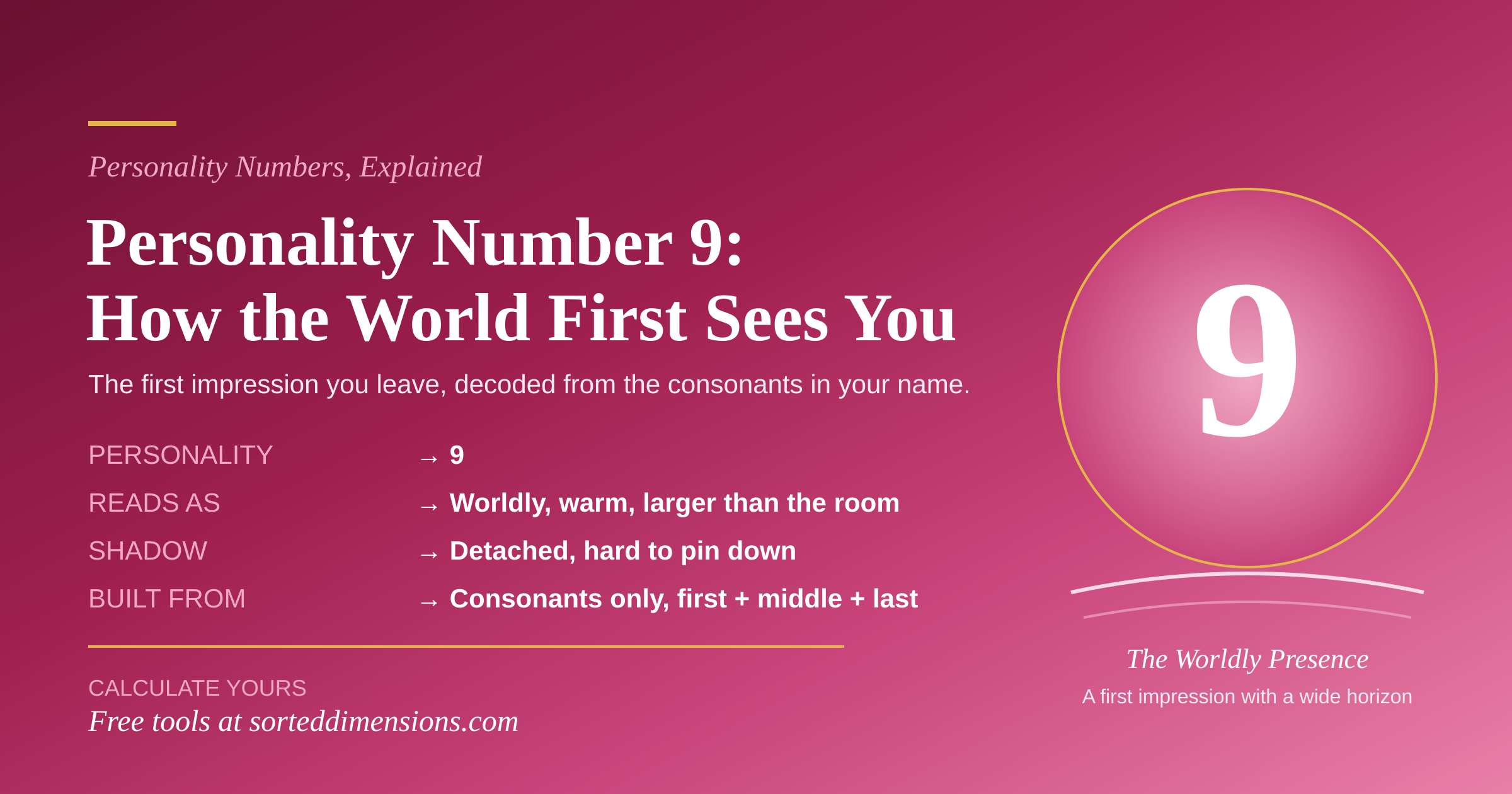
Personality Number 9: How the World First Sees You
Before anyone learns your story, your name has already told them something. Here is what a 9 tells them.
You walk into a room you've never been in before, full of people who know nothing about you, and within seconds something has already been decided. Not your résumé, not your history — just the shape of you, arriving ahead of the rest. If your Personality Number is 9, that shape tends to read as wide open: warm, worldly, and somehow bigger than the space you're standing in.
Quick answer: Personality Number 9 means people experience you, on first meeting, as broad-hearted and a little larger than life — a presence that seems to carry concern for more than just the people directly in front of it. The shadow is that this same breadth can read as distant, as though you're already halfway to caring about something else.
What the Personality Number actually is
Numerology splits your birth name into two separate signals. The vowels are read as your Soul Urge Number — the private wanting underneath everything you do. The consonants are read as your Personality Number — the outer shell, the part of you that meets a stranger before any conversation has happened. It isn't your whole self. It's closer to the cover of the book: accurate, but not the whole story, and worth knowing precisely because people judge books by it anyway.
Most of us spend very little energy managing our first impression on purpose, assuming people will "get to know us" and the surface will sort itself out. But the surface is doing work the whole time — in interviews, on first dates, in the first ninety seconds of a client pitch. The Personality Number describes the terms that surface is negotiating on, whether you've been steering it or not.
Why the number 9 impression specifically
Nine sits at the far end of the single-digit sequence, and in numerology it's read as the number of completion and range — the one that's already circled back around to include everyone else. Where a 1 impression reads as pointed and individual, and a 6 impression reads as devoted to the people closest by, a 9 impression reads as unbounded. You can seem, without trying, like someone who has already thought past the room you're standing in.
That's the gift: people are drawn to it because it feels generous, like standing near someone who has room for more than their own immediate concerns. The cost shows up in the same breath — if your concern is naturally wide, it's easy for the person directly in front of you to feel like one stop on a longer route rather than the destination. A 9 presence can come across as kind but hard to fully reach, warm but strangely impersonal.
How it's calculated — full worked example
The method uses only the consonants of your full birth-certificate name — first, middle, and last — run through the Pythagorean letter chart:
| 1 | 2 | 3 | 4 | 5 | 6 | 7 | 8 | 9 |
|---|---|---|---|---|---|---|---|---|
| A, J, S | B, K, T | C, L, U | D, M, V | E, N, W | F, O, X | G, P, Y | H, Q, Z | I, R |
Every letter that isn't a vowel counts as a consonant. A, E, I, O, U are always excluded. Y is excluded when it sounds like a vowel (as in "Mary") and included when it sounds like a consonant (as in "Yolanda"). Sum the consonant values within each name part separately, reduce that part's total to a single digit unless it's a Master Number (11, 22, or 33), then add the three name-part totals together and reduce the final sum the same way.
Example — singer Tina Turner was born Anna Mae Bullock. Her full documented birth name gives a Personality Number of 9, worked out like this:
- Anna: consonants N, N → 5 + 5 = 10 → reduces to 1
- Mae: consonant M → 4 (no reduction needed)
- Bullock: consonants B, L, L, C, K → 2 + 3 + 3 + 3 + 2 = 13 → reduces to 4
Add the three name-part totals: 1 + 4 + 4 = 9. Since 9 is a single digit and not 11, 22, or 33, no further reduction happens — it lands cleanly as the final Personality Number.
Anna Mae Bullock's consonants, reduced name-part by name-part, add up to a final Personality Number of 9.
Because a birth name's spelling can vary across records, and because Y's status shifts with pronunciation, it's worth running your own name through a careful, letter-by-letter check rather than eyeballing it.
Want your exact Personality Number without doing the arithmetic by hand? Run your full birth name through the calculator.
Open the Numerology ToolsWhat a 9 first impression looks like up close
People with a Personality Number 9 tend to get read a certain way before they've said much at all. Strangers describe them as easy to warm up to, hard to categorize, and somehow already familiar — the person at the party who seems to know a bit of everyone's world. There's a natural largeness to it: less "the specialist in the corner" and more "the person who's traveled, who's seen a few things, who could probably talk to anyone here."
That largeness comes with genuine upside. A 9 presence tends to put people at ease quickly, because there's an implicit generosity in it — the sense that you're not sizing someone up for what they can offer you specifically. In rooms where trust needs to form fast, that reads as a real asset, and recruiters, hosts, and first-meeting professionals with a 9 personality number often find people opening up to them unusually quickly.
The shadow is the flip side of the same coin. Because the presence naturally scales outward, individual people can end up feeling like they're getting a portion of your attention rather than the whole of it. Partners sometimes describe a 9 personality as loving but slightly unreachable — present in the room, but somehow already holding space for other people, other causes, other conversations. None of this means the warmth isn't real. It means the warmth is wide, and wide isn't always what the person in front of you is asking for.
Using this in real decisions
The value of knowing your Personality Number isn't philosophical, it's tactical. If your default first impression reads as broad and worldly, you can decide when to lean into that (client-facing work, hosting, situations that reward instant likability and range) and when to consciously narrow your focus (a first date, a one-on-one negotiation, any moment where the other person needs to feel like the only person in the room).
You can also use it to read other people more accurately. If someone's presence feels warm but oddly hard to pin down, a 9 personality number might explain the texture of that uncertainty — not as a verdict on their character, but as a pattern worth naming so you can ask better questions instead of guessing. See how this pairs with your Life Path or Soul Urge in the [related article — add URL] on reading a full numerology chart, and run your own numbers in the full set of calculators.
Frequently asked questions
What does Personality Number 9 mean?
It describes the impression you give off before anyone knows your history — a presence that reads as warm, worldly, and larger than the immediate room. People often feel drawn to a 9 presence without being able to say exactly why, and that pull is the number doing its work.
How is the Personality Number calculated?
Take only the consonants from your first, middle, and last name as they appear on your birth certificate, convert each to a number using the Pythagorean chart, total and reduce each name part separately, then add the three totals and reduce the final sum unless it's 11, 22, or 33.
Is Personality Number 9 the same as Life Path 9?
No. Life Path comes from your birth date and describes the terrain of your life overall. Personality Number comes from the consonants in your birth name and describes only the surface impression — what strangers pick up before they know anything else about you. You can run both through the tools page to compare.
Why do only consonants count toward the Personality Number?
In the Pythagorean tradition, vowels are read as the sound of your inner self and private wanting, while consonants carry the shape of your outer self — the version of you the world meets first. Splitting the two lets numerology separate what you feel from what you project.
What is the shadow side of Personality Number 9?
The same breadth that reads as warm and worldly can also read as detached. Because a 9 presence naturally holds concern for many things and many people at once, someone meeting you for the first time may feel like one of many rather than someone specific.
Can my Personality Number change if I go by a nickname?
The traditional calculation uses your full name as it appears on your birth certificate, not a nickname or a legally changed name. A nickname might shift how people experience you day to day, but the birth name stays the numerology reference point.
Does Y count as a vowel or a consonant in this calculation?
It depends on the sound. Y is treated as a vowel when it makes a vowel sound, such as in "Mary," and as a consonant when it makes a consonant sound, such as at the start of "Yolanda." When in doubt, say the name out loud and listen for which sound the Y is making.
What if my final total lands on 11, 22, or 33?
Those are Master Numbers and stay unreduced at both the name-part stage and the final stage — they're read as an intensified version of the single digit they'd otherwise reduce to. If your calculation stops at one of those, it's not an error; it's a different (and separately documented) Personality Number entirely.
Takeaway: Personality Number 9 gives you a wide, worldly first impression that people warm to fast and struggle to fully pin down. Know when that breadth serves you and when the moment calls for narrowing your focus to the one person actually in front of you.
If this resonates and you want the full system in one place, the book Sort Your Life by the Numbers: A practical introduction to the art of numbers walks through it step by step.