

Numerology Basics
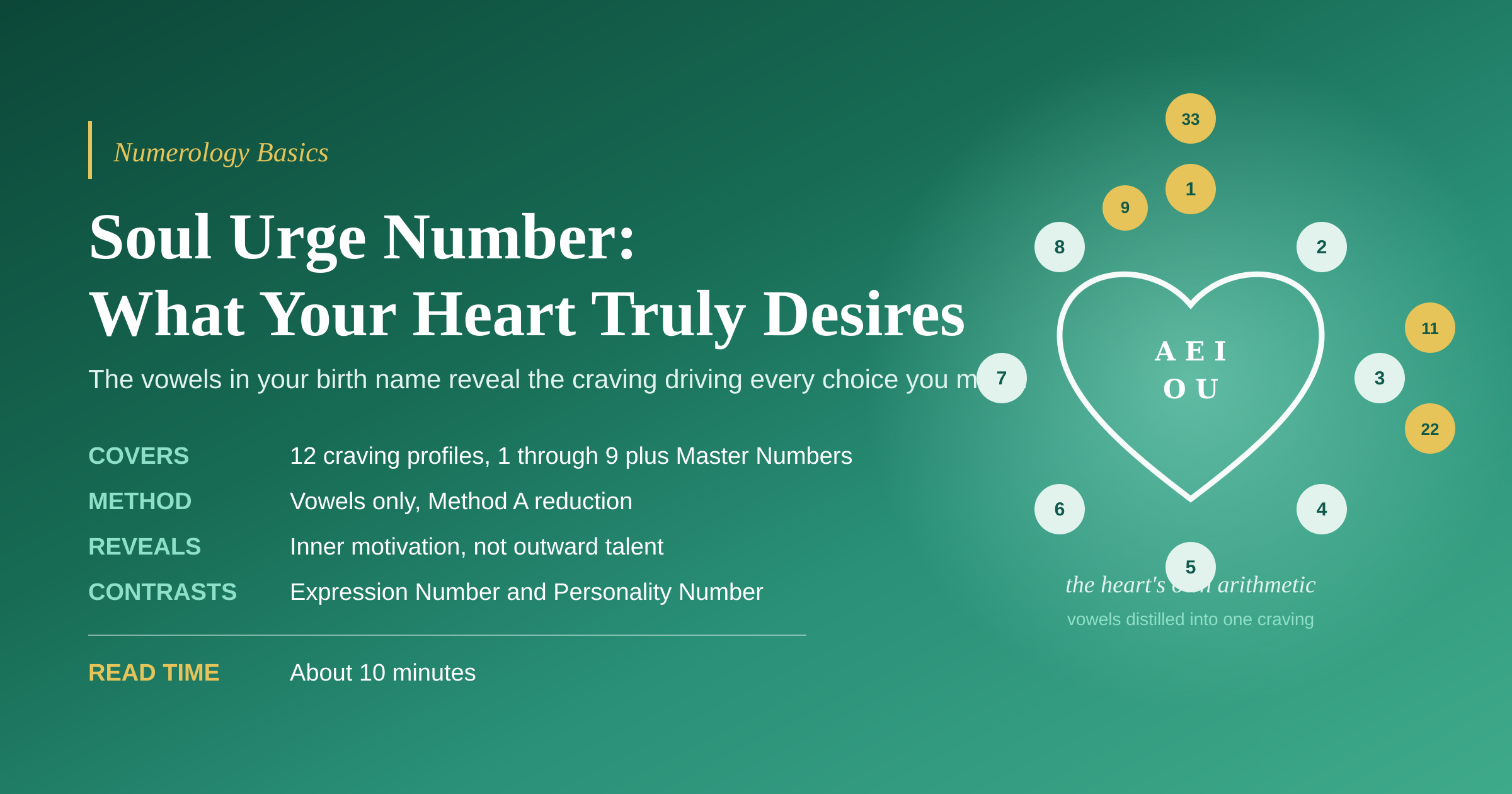
Soul Urge Number: What Your Heart Truly Desires
Your Soul Urge Number is built from nothing but the vowels in your birth name, and it names the craving that sits underneath everything you chase.
Quick answer: Your Soul Urge Number (also called the Heart's Desire Number) is calculated by pulling only the vowels from your full birth-certificate name, converting each to a Pythagorean value, reducing each name part while preserving Master Numbers, then summing and reducing again. The result — a digit from 1 to 9, or a Master Number 11, 22, or 33 — describes your innermost craving, the thing you want regardless of what you're skilled at or how others see you.
What the Soul Urge Number actually is
Every full name you were given at birth hides three separate numbers, and most people who've dabbled in numerology only ever meet one of them. The Expression Number uses every letter of your name — vowels and consonants together — and describes your natural talents, the abilities that show up whether you cultivate them or not. The Personality Number uses only the consonants, and it describes the impression you make on people who haven't gotten close to you yet: the surface, the handshake, the first ten minutes of a conversation. The Soul Urge Number is the third piece, and it's the quietest one. It strips away everything but the vowels — the letters you can't say a word without, the ones that carry the breath of the name — and what's left is a number that has nothing to do with skill or presentation. It's a craving.
Think about it this way. Expression is what you're capable of doing. Personality is how you land on a stranger. Soul Urge is what you actually want when nobody's grading you and nobody's watching. Two people can have the same Expression Number and be wildly different underneath it, because one of them craves recognition and the other craves peace, and that difference lives in the vowels, not the consonants.
This number goes by two names in the numerology world — Soul Urge and Heart's Desire — and they're used interchangeably. Both point at the same calculation and the same idea: whatever this digit is, it's the thing your heart keeps asking for, often before your conscious mind has caught up to admit it.
Why it matters
Most people make major decisions from the outside in. They pick a career because they're good at it, a partner because the relationship looks right on paper, a city because the job is there. The Soul Urge Number matters because it forces the question in the other direction: does this actually feed what you crave, or does it just use what you're capable of? A person with a Soul Urge of 5 can be extremely good at a stable, routine-heavy job — Expression numbers don't care about craving — and still feel quietly suffocated in it for fifteen years, because the craving for freedom was never being fed, only managed.
This is also why Soul Urge shows up so often in relationship friction that otherwise seems to come out of nowhere. Two people can be compatible on paper — similar values, similar goals, similar Life Paths — and still grind against each other because one partner's Soul Urge craves closeness and constant reassurance while the other's craves solitude and independent space. Neither craving is a flaw. But if nobody names them, both partners quietly experience the other as withholding or smothering, and neither one is right.
Knowing your own Soul Urge Number, and being honest about its shadow side, is one of the fastest ways to stop mistaking other people's cravings for your own — and to stop expecting other people to want what you want just because you get along.
How it's calculated, with a full worked example
The Soul Urge calculation rests on the same Pythagorean letter table used across Western numerology, the one that assigns every letter of the alphabet a number from 1 to 9 in repeating sequence:
| 1 | 2 | 3 | 4 | 5 | 6 | 7 | 8 | 9 |
|---|---|---|---|---|---|---|---|---|
| A | B | C | D | E | F | G | H | I |
| J | K | L | M | N | O | P | Q | R |
| S | T | U | V | W | X | Y | Z |
What makes the Soul Urge Number distinct isn't the table — it's the filter applied before you ever start adding. You only use the vowels, and the vowel rule has real precision to it, not the loose version people repeat casually:
- A, E, I, O, U are always treated as vowels, no exceptions.
- Y is a vowel only when it makes a vowel sound in that specific name — the Y in Lynn or Mary functions as a vowel, while the Y in Yusuf or Yolanda functions as a consonant because it opens the word with a consonant sound.
- W is a vowel only inside a true vowel-pair sound, such as the "aw" in Dawson or the "ow" combination in a name like Bradshaw — used alone at the start of a name, as in William, it stays a consonant.
Once the vowels are marked, the calculation follows what's usually called Method A, the traditional and most widely taught reduction:
- Write out your full name exactly as it appears on your birth certificate — first, middle, and last, no nicknames, no married names.
- Underline every vowel using the rule above.
- Convert each vowel to its Pythagorean number.
- Add the vowel values within each name part separately, and reduce that part's sum to a single digit — unless the sum lands on 11, 22, or 33, in which case you leave it as a Master Number and carry it forward unreduced.
- Add the reduced (or Master) values of all the name parts together, then reduce that final total the same way, again preserving 11, 22, or 33 if the total lands there.
Farrokh Bulsara, born name of Freddie Mercury, carries vowel values of 7 in the first name and 5 in the surname, summing to 12 and reducing to a Soul Urge of 3 — the craving for joyful self-expression, fitting for a performer built almost entirely around vocal and theatrical range.
Two more names, for pattern recognition
Marguerite Annie Johnson (Maya Angelou's birth name): MARGUERITE gives vowels A-U-E-I-E = 1+3+5+9+5 = 23 → 5. ANNIE gives A-I-E = 1+9+5 = 15 → 6. JOHNSON gives O-O = 6+6 = 12 → 3. Summed: 5+6+3 = 14 → 5. Soul Urge = 5, the craving for freedom and lived experience — a fitting undertone for a life spent moving through so many countries, languages, and reinventions before the writing itself.
Albert Einstein (no middle name on record): ALBERT gives A-E = 1+5 = 6. EINSTEIN gives E-I-E-I = 5+9+5+9 = 28 → 10 → 1. Summed: 6+1 = 7. Soul Urge = 7, the craving for truth and solitary thought, which tracks with a mind famous for needing quiet, unstructured time to think rather than collaborative noise.
These are offered as illustrative examples of the method using well-documented birth names, not as claims about anyone's private inner life — the value is in seeing the same steps applied to three very different names.
Doing this by hand is good for understanding it once. After that, let a calculator carry the vowel-by-vowel work.
Calculate your Soul Urge NumberA tour of every craving, 1 through 33
What follows is every Soul Urge digit, named plainly — the craving it points to, and the shadow that craving casts when it's fed unconsciously instead of on purpose. None of these are verdicts. They're patterns worth recognizing in yourself before they run you, the same way you'd recognize a pattern in a full numerology chart rather than a single isolated number.
1 Soul Urge 1
You crave independence — not company, not consensus, the freedom to lead on your own terms and answer to no one else's pace. Being first matters less than being uncontrolled. Fed consciously, this craving builds people who start things nobody else would dare start. Fed unconsciously, it curdles into an inability to accept help even when you're drowning, because accepting help feels indistinguishable from losing control.
2 Soul Urge 2
You crave closeness — real harmony, the specific comfort of being deeply understood by one or two people rather than admired by a crowd. Conflict doesn't just bother you, it feels like a small structural failure. Fed consciously, this makes you the person who holds relationships together with patient, careful attention. Fed unconsciously, it turns into people-pleasing so automatic you stop noticing you've disappeared inside everyone else's preferences.
3 Soul Urge 3
You crave joyful self-expression — the release of getting something out of you and into the world, whether that's a song, a joke, a story, or just being genuinely seen mid-laugh. Silence feels like suppression. Fed consciously, this craving makes you a source of real warmth and creative energy for people around you. Fed unconsciously, it becomes a need for constant validation, where every expression is quietly a request: did that land, was that good, am I still interesting.
4 Soul Urge 4
You crave order — dependability, a structure you can actually trust to hold, systems that work the same way twice. Chaos doesn't excite you, it drains you. Fed consciously, this craving makes you the person others rely on because you actually follow through. Fed unconsciously, it hardens into rigidity, where deviation from the plan feels like a personal threat rather than a normal feature of being alive.
5 Soul Urge 5
You crave freedom and new experience — the next place, the next idea, the next version of a life that hasn't calcified yet. Routine, held too long, starts to feel like a small death. Fed consciously, this craving makes you adaptable in ways that serve you across an entire lifetime. Fed unconsciously, it becomes restlessness so constant that nothing gets to finish, including relationships, before you're already reaching for the exit.
6 Soul Urge 6
You crave being needed — a home, a family, a circle of people whose lives are visibly better because you're in them. Care isn't an obligation for you, it's closer to a language. Fed consciously, this craving makes you the person a household or a community actually depends on, gladly. Fed unconsciously, it becomes over-involvement, where you're managing other people's problems as a way of avoiding your own, and calling it love.
7 Soul Urge 7
You crave truth and solitude — real answers, not comfortable ones, and enough quiet to actually think them through without noise. Small talk exhausts you faster than hard problems do. Fed consciously, this craving produces genuine depth, the kind of insight that only comes from sitting with something alone. Fed unconsciously, it becomes emotional withdrawal, where the retreat into your own head stops being restorative and starts being a wall nobody, including people who love you, can get past.
8 Soul Urge 8
You crave recognition and material security — not vanity, but the tangible proof that your effort produced something real: status, resources, evidence you moved the needle. Fed consciously, this craving builds genuine competence and the confidence to steward real responsibility. Fed unconsciously, it becomes a hunger that never actually closes — every milestone reached just relocates the goalpost, and "enough" stops being a real destination.
9 Soul Urge 9
You crave contributing to something larger than yourself — a cause, a community, a species-level "we" rather than a private "me." Personal gain that doesn't serve anyone else feels oddly hollow to you. Fed consciously, this craving produces real generosity and a genuinely wide-angle compassion. Fed unconsciously, it becomes martyrdom, where your own needs are quietly ranked last so often that resentment builds underneath the giving without you naming it as resentment.
11 Soul Urge 11/2 (Master Number)
You crave meaning and connection, but at a heightened, almost electric intensity — the 2's closeness dialed up until ordinary relationships and ordinary insight both feel too small to hold what you're sensing. Fed consciously, this craving produces people with unusual intuitive reach, who pick up on what others miss entirely. Fed unconsciously, it becomes anxiety and overwhelm, because a nervous system built for that much sensitivity has no natural off switch, and the intensity that could be a gift starts to just feel like too much, all the time.
22 Soul Urge 22/4 (Master Number)
You crave building something lasting — not for yourself alone, but structures, institutions, or projects that outlive you and genuinely serve other people at scale. It's the 4's order, but aimed at a much bigger blueprint. Fed consciously, this craving is rare and genuinely constructive — the kind of person who builds things that hold for decades. Fed unconsciously, it becomes crushing pressure, because the gap between "what I could build" and "what currently exists" never fully closes, and rest starts to feel like failure.
33 Soul Urge 33/6 (Master Number, rare)
You crave healing others at scale — the 6's caretaking instinct, expanded until it's aimed less at your own household and more at anyone within reach who's suffering. This Soul Urge is genuinely uncommon in a name calculation. Fed consciously, this craving produces people capable of extraordinary, selfless service. Fed unconsciously, it becomes martyrdom taken to its extreme — a near-total erasure of personal need in service of everyone else's, until there's nothing left to give from and the giving becomes hollow, or resentful, or both.
Quick-reference table
| Digit | Craves | Shadow |
|---|---|---|
| 1 | Independence, leading on your own terms | Can't accept help |
| 2 | Closeness and harmony | People-pleasing |
| 3 | Joyful self-expression | Needs constant validation |
| 4 | Order and dependability | Rigidity |
| 5 | Freedom and new experience | Restlessness |
| 6 | Being needed, creating a home | Over-involvement |
| 7 | Truth and solitude | Emotional withdrawal |
| 8 | Recognition and material security | Never satisfied |
| 9 | Contributing to something larger than self | Martyrdom |
| 11/2 | Meaning and connection, heightened intensity | Anxiety, overwhelm |
| 22/4 | Building something lasting for others | Crushing pressure |
| 33/6 | Healing others at scale, often at personal cost | Martyrdom taken to an extreme |
The nine base cravings sit closest to the core because they're the raw material. The three Master Numbers sit apart because they're not new cravings — they're the same ones turned up until the volume itself becomes part of the story.
Using this number in real life
The most immediate use of your Soul Urge Number is naming, out loud, what you actually want — not what you've been trained to say you want, not what looks reasonable on a resume or a dating profile, the raw craving underneath it. A Soul Urge 8 who keeps choosing low-visibility, low-recognition roles because they seem more virtuous is going to feel a quiet, specific hunger no amount of "should" will resolve. Naming the craving doesn't mean indulging it recklessly. It means stopping the argument with yourself about whether it's allowed to exist.
In relationships, comparing Soul Urge Numbers explains friction that Life Path comparison alone often misses, because Life Path is about direction and Soul Urge is about need. A 2 and a 7 can share a Life Path, a home, and a decade together, and still misread each other constantly — the 2 experiences the 7's need for solitude as rejection, and the 7 experiences the 2's need for closeness as intrusion, when both are simply feeding different, valid cravings. Once you can say "my Soul Urge craves X and yours craves Y," the friction usually stops being a referendum on the relationship and starts being a logistics problem: how do we build room for both.
Soul Urge is also worth checking against your Expression Number specifically, because the gap between them is often where burnout lives. If your Expression Number points you toward visible, structured, detail-heavy work, and your Soul Urge craves freedom and unstructured movement, you can be objectively excellent at your job and still feel slowly hollowed out by it — not because you're failing, but because talent and craving were never the same axis to begin with. A full chart comparison that lays Expression, Personality, and Soul Urge side by side usually makes this gap visible in about five minutes, where journaling about it can take years.
Finally, treat the shadow side of your number as information, not a character flaw. A Soul Urge 6 who over-functions for everyone in the house isn't broken — they're feeding a real craving to be needed, just without a boundary on it. The fix generally isn't "stop caring." It's learning to feed the craving in a way that has an edge to it, so the caretaking doesn't quietly become the only load-bearing wall in every relationship you're in. Running your own name through a Soul Urge and Expression comparison is usually the fastest way to see where that edge needs to go.
Frequently asked questions
What is the difference between the Soul Urge Number and the Expression Number?
The Expression Number uses every letter in your full birth name and describes your outward talents and natural abilities. The Soul Urge Number uses only the vowels and describes the private craving behind those talents — what you want, not what you're good at.
How do I calculate my Soul Urge Number?
Write your full birth-certificate name, pull out every vowel (A, E, I, O, U, plus Y and W when they sound like vowels), convert each vowel to its Pythagorean number, reduce each name part separately while preserving Master Numbers 11, 22, and 33, then add the reduced parts together and reduce the total the same way.
Does the Soul Urge Number use my full birth name or my current name?
Traditional practice uses the full name exactly as it appears on your original birth certificate, including any name you no longer go by, because it captures the vibration you were born into. A current or married name can be calculated separately as an overlay, but it doesn't replace the birth-name calculation.
Is Y a vowel or a consonant in numerology?
It depends on the sound. Y is a vowel when it makes a vowel sound, as in Mary or Lynn, and a consonant when it makes a consonant sound, as in Yolanda or Yusuf. The same letter can go either way depending entirely on the name it appears in.
What does it mean if my Soul Urge Number is a Master Number like 11, 22, or 33?
A Master Number Soul Urge means the underlying craving of 2, 4, or 6 is present at a heightened, more demanding intensity, along with a greater capacity and a greater risk of overwhelm. It isn't automatically "better" than a base digit — it simply carries more voltage.
Can two people with the same Life Path have different Soul Urge Numbers?
Yes. Life Path comes from your birth date and Soul Urge comes from your name, so they are calculated independently and often differ, which is part of what makes a full chart layered rather than a single label.
Why do numerologists use the birth-certificate name instead of a nickname?
The birth-certificate name is treated as the fixed vibrational blueprint you arrived with. A nickname or married name is analyzed separately, as an overlay, rather than replacing the original calculation.
Can my Soul Urge Number change over time?
The number itself does not change because it is fixed to your birth name, but how consciously you meet that craving, and how much you let its shadow run the show, can change substantially across your life.
Where can I check my exact Soul Urge Number without doing the vowel math by hand?
A Soul Urge calculator applies the vowel rules and the Master Number checks automatically, which matters most for names with tricky Y or W placement where hand calculation is easy to get subtly wrong.
Takeaway: Your Soul Urge Number is the vowel-only signature hidden inside your birth name, and it names a craving, not a skill — the thing you want regardless of what you're good at or how you come across. Every digit from 1 to 9, and the three intensified Master Numbers above them, pairs a genuine gift with an honest shadow, and the goal was never to pick the "good" number. It's to feed the craving on purpose instead of letting the shadow feed it for you.
Related reading: Expression Number: Your Natural Talents Decoded [related article — add URL] · Personality Number: The First Impression You Make [related article — add URL] · Master Numbers 11, 22, and 33 Explained [related article — add URL]
If this resonates and you want the full system in one place, the book Sort Your Life by the Numbers: A practical introduction to the art of numbers walks through it step by step.