
Master Numbers in Numerology
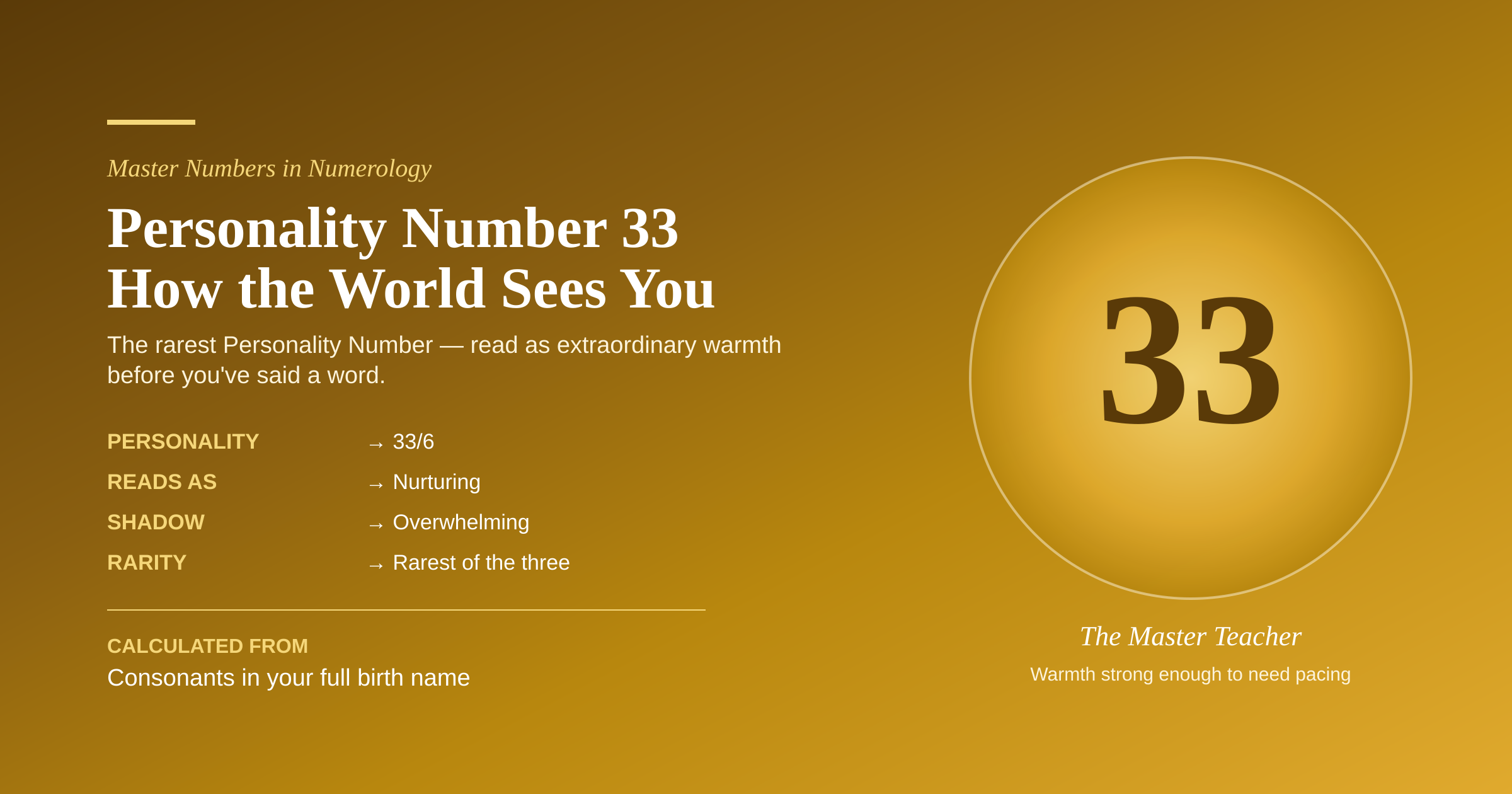
Personality Number 33: How the World First Sees You
The rarest first impression in numerology — read as extraordinary warmth before you've said a word.
You walk into a room and something happens before you speak. People soften. They lean in a little, the way they might with someone they already trust, even though you've just met. If your Personality Number is 33, this isn't your imagination — it's the outer layer of your name doing exactly what it was built to do.
Quick answer
Personality Number 33 means people read you, on first meeting, as unusually warm and nurturing — almost like a natural caretaker, even in a two-minute conversation. It is the rarest Personality Number because it requires an exceptionally high consonant sum across your full birth name. The shadow: that much immediate warmth can feel like it needs paying back, so people sometimes go quiet, unsure what's being asked of them.
What the Personality Number actually is
Your Personality Number isn't your whole chart. It's the surface — the part of you a stranger meets in an elevator, a first date, a job interview, the first five minutes of a client call. Numerology draws this number from the consonants in your full birth-certificate name because consonants, in this tradition, carry the structural, outward-facing sound of a name, while vowels carry the inner, private sound reserved for the Soul Urge Number.
That distinction matters. Your Life Path Number describes the terrain of your whole life. Your Soul Urge describes what you want when no one's watching. Your Personality Number describes the door — what people see before they're invited past it. You can learn to work with that door consciously once you know what it looks like from the outside.
Why the Personality Number matters
First impressions compress a lot of decision-making into a short window. Whether someone hires you, trusts you with a secret, or opens up in a first conversation often gets decided before your character has had a chance to show itself in full. Knowing your Personality Number gives you language for a pattern you've probably noticed anecdotally your whole life — the way people react to you before they know you. That's useful information for interviews, first dates, public speaking, and any situation where a stranger has to make a fast read.
For a 33 specifically, this matters more than usual, because the read is so strong. People don't just find you pleasant — they often feel cared for almost immediately, which can open doors quickly or, if you don't manage it, close them just as fast.
How Personality Number 33 is calculated
The method uses only consonants — never vowels. A, E, I, O, and U are always excluded. Y is excluded when it makes a vowel sound (as in "Kelly") and included when it makes a consonant sound (as in "Yolanda"). W is treated as a consonant except in the rare true vowel-pair sound. Each remaining consonant gets a value from the standard Pythagorean chart:
| Value | Letters |
|---|---|
| 1 | A, J, S |
| 2 | B, K, T |
| 3 | C, L, U |
| 4 | D, M, V |
| 5 | E, N, W |
| 6 | F, O, X |
| 7 | G, P, Y |
| 8 | H, Q, Z |
| 9 | I, R |
Sum the consonant values in the first name, then reduce to a single digit — unless that sum itself lands on 11, 22, or 33, in which case you leave it alone. Do the same, separately, for the middle name and the last name. Add the three totals together, then reduce that final sum the same way, protecting 11, 22, and 33. Reaching 33 at the end is unusual: it takes either one name part that already lands on a Master Number, or several parts whose reduced values happen to add up perfectly to 33 without a smaller Master Number showing up along the way and getting reduced.
Example — Charles Robert Darwin
This is a documented historical figure, not a hypothetical, and his full birth name is well recorded: Charles Robert Darwin, the English naturalist born in 1809. Here is the consonant math, part by part.
| Name part | Consonants and values | Sum | Reduced (protecting Master Numbers) |
|---|---|---|---|
| CHARLES | C=3, H=8, R=9, L=3, S=1 | 24 | 2+4 = 6 |
| ROBERT | R=9, B=2, R=9, T=2 | 22 | 22 is a Master Number — kept as is |
| DARWIN | D=4, R=9, W=5, N=5 | 23 | 2+3 = 5 |
Final total: 6 (Charles) + 22 (Robert) + 5 (Darwin) = 33. Since 33 is a Master Number, it is not reduced further. Personality Number: 33/6.
Notice what made this work: the middle name, Robert, already summed to 22 — a Master Number in its own right — and stayed unreduced through the final addition. That's the mechanism behind almost every real 33: at least one name part carries an unusually high consonant load, and the other parts land in a way that completes the sum to exactly 33 rather than overshooting into a different number or undershooting into an ordinary one. This is precisely why a Personality Number of 33 is the rarest of the three Master Number outcomes — most names simply don't have the consonant weight to reach it.
Charles Robert Darwin's three name parts, reduced separately and added, land exactly on the Master Number 33 — written 33/6.
Want to run your own full name through this calculation without doing it by hand? Use the free calculator.
Open the Numerology ToolsWhat Personality Number 33 means
At its root, 33 carries the frequency of 6 — the number of care, responsibility, and service to others. But 33 doesn't just carry that frequency, it amplifies it. Where a Personality Number 6 reads as reliable and kind, a 33 reads as something closer to a caretaker on sight. People who meet you for the first time often report feeling unusually comfortable, unusually fast — as though you'd remembered something about them they hadn't told you yet.
This shows up in small, concrete ways: you're the one strangers ask for directions, the one a nervous coworker sits next to in a meeting, the one a crying stranger on a train ends up talking to. It's not effort on your part. It's what your name projects before you've done anything at all.
The shadow side is worth naming plainly, because it's easy to miss when the surface reading is this flattering. That much immediate warmth can feel like too much, too soon. People sometimes read it as a demand rather than a gift — as if all that care must be leading somewhere, must require something back. Some will pull away, not because they dislike you, but because they don't know what you want in return for feeling so instantly looked after. Others may lean on you harder and faster than the relationship has earned, treating your first-impression warmth as a standing invitation to unload.
The most useful thing you can do with a Personality Number 33 is let people earn the depth of that warmth over time instead of handing them all of it in the first conversation. You don't have to perform less care — you have to pace it. Trust that builds gradually tends to hold. Trust that arrives all at once in the first five minutes tends to make people wonder what's underneath it, and sometimes that wondering is what pushes them back rather than closer.
Using this number in practical decisions
If you know your Personality Number is 33, you can use that information instead of just being subject to it. Before a first meeting that matters — a job interview, an investor pitch, a first date — you can decide, on purpose, to let the initial warmth show but hold some of it in reserve. Ask a question before you offer comfort. Let the other person talk first. That single adjustment changes how a 33's natural warmth lands: from "this is a lot" to "this feels earned."
It also helps to know this number isn't the whole story of who you are. It's the door, not the house. If you've ever felt like people expect a level of caretaking from you that you can't sustain, or that new acquaintances seem to assume more closeness than you've actually built with them, this number is very likely part of why. Naming it takes some of the mystery — and some of the exhaustion — out of that pattern.
Frequently asked questions
What is a Personality Number in numerology?
The Personality Number is calculated from only the consonants in your full birth-certificate name. It reflects the impression you make on people before they know you well — the outer layer, not the whole picture.
How rare is Personality Number 33?
Extremely rare. It requires an unusually high consonant sum across the first, middle, and last name that lands on exactly 33 after each part is calculated and the parts are added together. Most names never come close — you typically need at least one name part that already sums to a Master Number on its own, with the remaining parts completing the total precisely.
How do you calculate Personality Number 33?
Assign Pythagorean values to every consonant in the first, middle, and last name separately. Add each part's consonant values, reducing to a single digit unless the part itself is 11, 22, or 33. Add the three part-totals together, then reduce that final sum the same way. If the final sum is 33, it stays 33 and is written 33/6.
Is 33 the same as 6 in numerology?
33 carries the foundation of 6 (3+3=6, the number of care and responsibility) but operates at a more intense, less reducible level. It's written 33/6 to show both the master frequency and its root, and the two are read together rather than as competing meanings.
What does Personality Number 33 mean for first impressions?
People tend to read you as unusually warm and caring right away, almost like a natural caretaker even in brief encounters. The shadow side is that this warmth can feel overwhelming or make people wonder what is expected of them in return.
Can a Personality Number change over your life?
No. It's fixed by the consonants in your birth-certificate name, so it doesn't change as you age or as circumstances change. What can change is how consciously you pace the impression it creates.
Does a nickname or married name change my Personality Number?
No. The calculation uses your full name exactly as it appears on your birth certificate, not a nickname, married name, or stage name. If you want to explore how a name change shifts the numbers, the calculator can run both versions side by side.
Takeaway: Personality Number 33 gives you a first impression most people spend years trying to build — instant, visible warmth. The work isn't creating more of it. It's learning to release it at a pace that lets trust catch up, so the caretaking that comes naturally to you reads as a gift being offered rather than a debt being opened.
For more on how this number interacts with your Life Path, see [related article — add URL], and for the full picture of how Personality Numbers pair with Expression Numbers, see [related article — add URL]. You can also calculate your own full profile any time with the numerology tools.
If this resonates and you want the full system in one place, the book Sort Your Life by the Numbers: A practical introduction to the art of numbers walks through it step by step.