
Personality Number 11: How the World First Sees You
The first ninety seconds someone spends with you are not random. Your birth name is quietly setting the tone before you say a word — and if your Personality Number is 11, that tone is magnetic, intense, and a little otherworldly.
The Direct Answer
If your Personality Number is 11, people register something unusual about you before they can name it. You come across as watchful, composed, and quietly perceptive — the person in the room who seems to be reading everyone else's undercurrents while giving away very little of your own. It reads as magnetic. It can also read as intimidating, because the depth people sense in you doesn't always arrive with matching warmth. Both are true, and you can learn to lead with the first.
Quick Answer
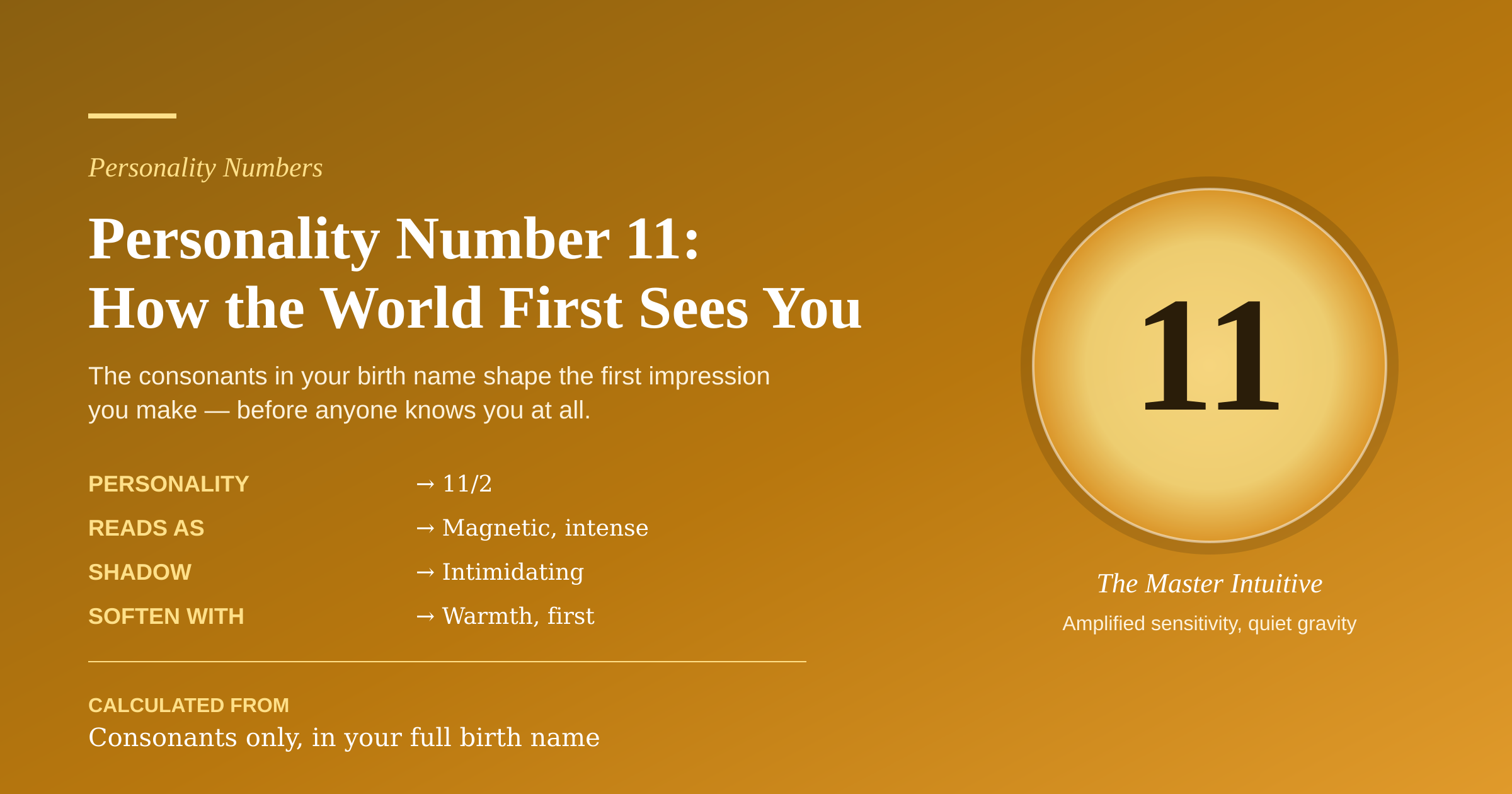
Personality Number 11 (written 11/2) is a Master Number first impression: people read you as intense, intuitive, and slightly mysterious on first contact. Gift: magnetic presence, natural gravity, a sense that you notice more than you say. Shadow: can feel cold, guarded, or hard to approach until you consciously soften. It comes from the consonants only in your full birth name — not your birthday, and not your talents.
What the Personality Number Actually Measures
Numerology gives you several numbers built from the same birth name, and it's easy to blur them together. Your Expression Number (built from every letter) describes your natural talents and the work you're built to do. Your Soul Urge Number (built from only the vowels) describes what you privately crave and what actually satisfies you. Your Personality Number is built from what's left over — the consonants only — and it describes neither your talent nor your craving. It describes your surface. The mask, the first handshake, the impression a stranger forms in the time it takes to cross a room.
This distinction matters because a lot of people spend years trying to fix a "personality problem" that is really just an unmanaged first impression. You can have deep warmth (Soul Urge) and real talent (Expression) and still walk into a room reading as unreachable, because your Personality Number is doing something entirely different from either of those numbers. Learn more about how these numbers work together in our numerology tools section, where you can calculate all three side by side.
Why It Matters
You don't get to control most first impressions directly — but you can understand the shape of the one you're already making, and adjust the parts that are within reach: posture, pacing, warmth cues, the first sentence out of your mouth. An 11 personality is a strong signal. It draws attention reliably. The only question is whether you let that attention resolve into connection or let it calcify into distance. People with this number who understand it tend to become the ones others describe as "intense but incredible once you get to know them." People who don't understand it are often just described as "intense," full stop, and never get the second half of that sentence.
How It's Calculated — Full Worked Example
The Personality Number uses only the consonants of your full birth-certificate name — first, middle, and last — converted with the Pythagorean chart below.
| 1 | 2 | 3 | 4 | 5 | 6 | 7 | 8 | 9 |
|---|---|---|---|---|---|---|---|---|
| A, J, S | B, K, T | C, L, U | D, M, V | E, N, W | F, O, X | G, P, Y | H, Q, Z | I, R |
Every letter that isn't a vowel counts as a consonant. A, E, I, O, U are always excluded. Y swings both ways — it's a vowel when it makes a vowel sound (as in "Sally") and a consonant when it makes a consonant sound (as in "Yolanda"). W is almost always a consonant. Sum the consonants in the first name and reduce, unless that sum is itself a Master Number (11, 22, 33) — in which case you keep it whole. Do the same, separately, for the middle name(s) and the last name. Then add the three totals and reduce the final sum, again preserving 11, 22, or 33 if that's what you land on.
Example — physicist Albert Einstein makes a clean, well-documented case. His full legal birth name carries no middle name, which keeps the math transparent:
ALBERT: consonants are L, B, R, T → L=3, B=2, R=9, T=2 → 3+2+9+2 = 16 → 1+6 = 7
EINSTEIN: consonants are N, S, T, N → N=5, S=1, T=2, N=5 → 5+1+2+5 = 13 → 1+3 = 4
Total: 7 (first name) + 4 (last name) = 11. Since 11 is a Master Number, it is not reduced further. Albert Einstein's Personality Number is 11/2 — and it's worth noting how well that tracks with his public reputation: the wild hair and the far-off gaze read as otherworldly and faintly unreachable long before anyone knew what he'd actually discovered.
Fig. 1 — Albert Einstein's Personality Number: consonants only, summed by name part (7 + 4), preserved as the Master Number 11.
Notice the two safeguards built into this method. First, a name part can itself land on a Master Number — if "ALBERT" had summed to 11 or 22 directly, you'd keep it whole rather than reducing it to a single digit before adding it to the other parts. Second, the final total gets the same protection: 11, 22, and 33 are never collapsed down to 2, 4, or 6. That preservation is what makes a Master Number result meaningful instead of an artifact of rounding.
Want your own Personality Number calculated instantly, alongside your Soul Urge and Expression numbers?
Use the Free Numerology ToolsWhat Personality Number 11 Really Means
Every Master Number is an amplified version of its root digit, and 11 is the doubled charge of the 2 — partnership, sensitivity, and pattern-reading, turned up until it becomes something closer to a presence than a trait. People with an 11 personality don't just seem nice or seem sharp on first meeting. They seem to be somewhere slightly apart from the room, watching it, feeling it, absorbing more of it than they let show. That's the "otherworldly" quality people reach for when they try to describe you and end up saying something vague like "there's something about them."
The Gift
You carry a natural gravity. People notice you without you performing for it. Your presence alone signals depth, and that depth draws the kind of attention that lasts — colleagues remember you, rooms quiet slightly when you speak, and people sense, correctly, that you're picking up on things they haven't said out loud.
The Shadow
That same depth can arrive without warmth attached, and warmth is what tells people it's safe to approach. Left unmanaged, an 11 personality reads as intimidating, aloof, or faintly judgmental — not because you are any of those things, but because intensity without an accompanying softness gives people nothing to hold onto.
The honest work here isn't pretending to be less perceptive or less intense — it's learning to soften the delivery so the depth becomes an invitation instead of a wall. A genuine smile that arrives a beat sooner than feels natural. A question about the other person before they've had to ask one of you. A slightly more relaxed posture in the first thirty seconds of any interaction. None of this dims the 11. It just gives people a door into it, instead of leaving them standing outside a presence they can sense but can't enter.
Using This in Real Life
In interviews, an 11 personality often works in your favor without effort — composure and quiet gravity read as leadership potential, especially for roles that require presence under pressure. The risk is in more casual team settings, where the same intensity can be misread as disengagement or judgment before anyone has had the chance to see your actual warmth. A deliberate, slightly-earlier-than-instinctive smile in the first exchange goes a long way toward correcting that read before it hardens into an opinion.
In dating, this number tends to generate curiosity fast — people are drawn to figure you out, which can feel flattering and can also feel like being studied rather than met. The adjustment isn't to perform less depth; it's to reciprocate visibility a little sooner than feels comfortable, so the connection doesn't stall out at "intriguing" and never reach "known."
In networking, this number is genuinely useful — people remember an 11 presence in a room of forgettable handshakes. Pair that memorability with one unguarded, personal detail early in the conversation, and the intensity turns into rapport instead of distance. You can run these dynamics against your specific name and birth date with the calculators in our free numerology tools, which also break down how your Personality Number interacts with your Life Path and Expression Number.
For a deeper look at how this first-impression layer interacts with your inner motivations, see our companion piece on Soul Urge Number 11: What You Secretly Want [related article — add URL], and for the full picture of how Master Numbers behave across every core chart position, see Understanding Master Numbers 11, 22, and 33 [related article — add URL].
Frequently Asked Questions
What does Personality Number 11 mean?
It describes the first impression you make on strangers: magnetic, intense, and a little otherworldly, as if you're quietly reading the room before anyone reads you. As a Master Number, it carries the amplified charge of the 2 — heightened sensitivity and intuition — rather than reducing to a plain single digit.
How is the Personality Number calculated?
Take only the consonants of your full birth-certificate name. Convert each to a number using the Pythagorean chart, sum and reduce your first name (unless it's a Master Number), do the same separately for your middle name(s) and last name, then add the three totals and reduce the final sum unless it lands on 11, 22, or 33.
Is Personality Number 11 the same as Life Path 11?
No. Life Path comes from your birth date and describes your life's overall direction and lessons. Personality Number comes from the consonants in your birth name and describes only the surface impression strangers form before they know you.
Why does Personality Number 11 feel intimidating to some people?
An 11 personality radiates depth and intensity before it radiates warmth. People sense there's more going on beneath the surface, and that unspoken weight can read as distance or judgment even when none is intended.
Can I change how my Personality Number 11 comes across?
You cannot change the number itself, but you can change how you carry it. Small, deliberate warmth cues — an easy smile, a lighter opening line, an unguarded question — invite people past the intensity instead of asking them to push through it on their own.
Does Personality Number 11 affect dating and interviews?
Yes. In interviews it often reads as unusual composure and presence, useful in roles that need gravity, though it can seem guarded in casual team settings. In dating, it draws people in fast on curiosity, then requires you to actually let them see behind the intensity for the connection to deepen.
What is a Master Number in numerology?
A Master Number — 11, 22, or 33 — is a sum traditionally left unreduced because it carries a more concentrated, higher-voltage version of its root single digit. 11 is the amplified 2: intuition, sensitivity, and vision, turned up rather than smoothed out. You can calculate your own with the free numerology tools.
Takeaway
Takeaway: Your Personality Number 11 isn't a flaw to manage — it's a strong first note that needs one more note played alongside it. The depth is already working for you. Add a beat of warmth before anyone has to go looking for it, and the same intensity that reads as distance in a stranger reads as gravity in someone people trust.
If this resonates and you want the full system in one place, the book Sort Your Life by the Numbers: A practical introduction to the art of numbers walks through it step by step.