
Personality Numbers, Explained
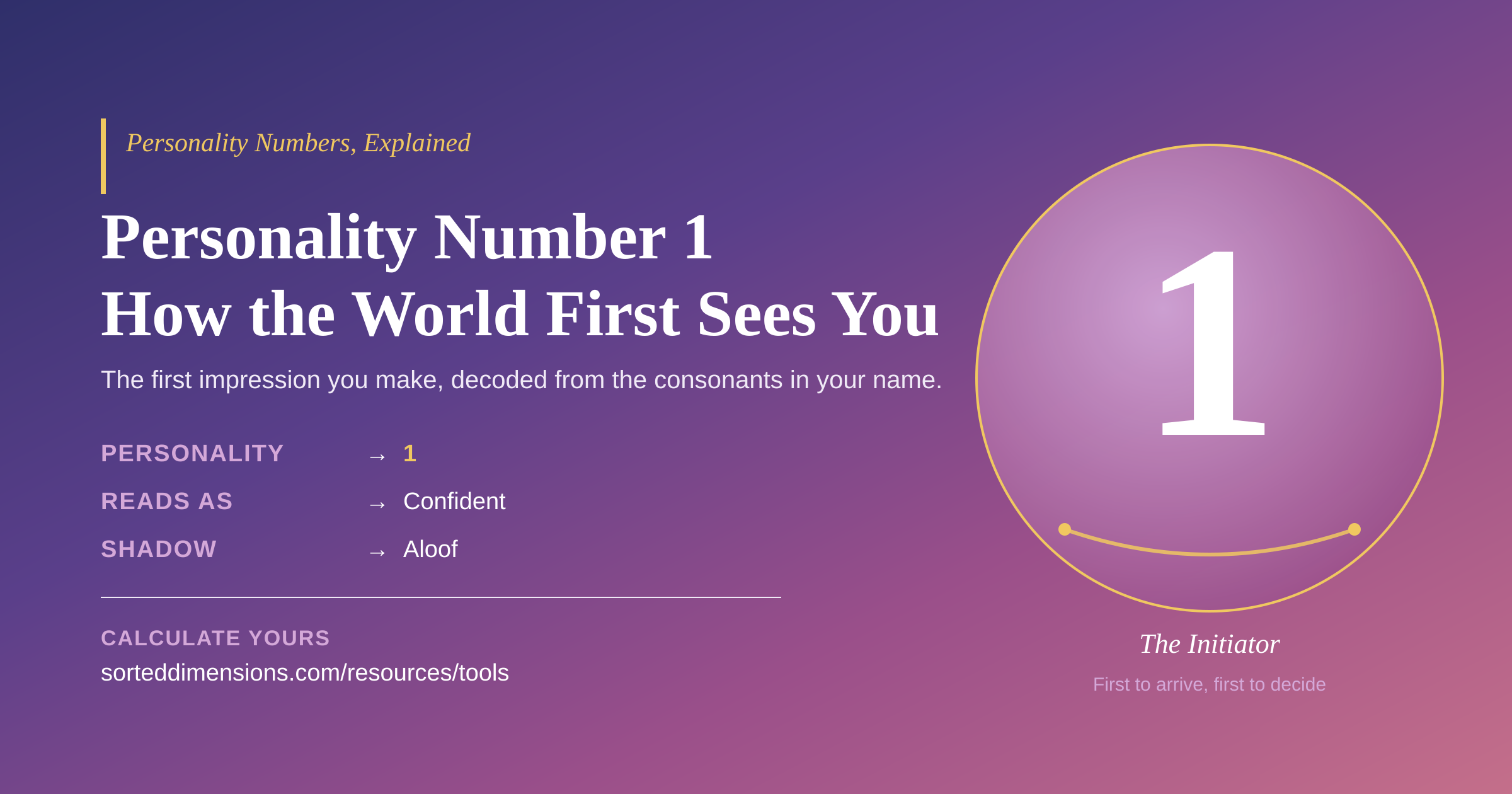
Personality Number 1: How the World First Sees You
The consonants in your birth name carry a first-impression signature. If yours reduces to 1, people read you as certain before you've said much of anything.
You walk into a room and, within seconds, before you've spoken more than a sentence, people have already formed an opinion. That's not vanity or bias — it's information moving fast, and numerology has a name for the layer that transmits it: the Personality Number. If yours is 1, the signal you're sending reads as confident, capable, and already oriented toward where you're headed. You can check yours directly using the Personality Number calculator while you read.
Quick answer
Personality Number 1 means people's first read on you is confident, self-possessed, and quietly in charge — even when you don't feel that way inside. The risk is that this same certainty can look distant or competitive before anyone gets close enough to see what's underneath it.
What the Personality Number actually is
Numerology works with several numbers pulled from your name and birth date, and each one answers a different question. Life Path asks what your overall direction is. Soul Urge asks what you privately crave. Expression asks what you're naturally capable of. The Personality Number asks something narrower and more practical: what does a stranger pick up on in the first ninety seconds?
That narrowness is the point. Personality is calculated from only the consonants in your full birth name — the sounds that give a name its edges and structure, stripped of the vowels that soften it. Vowels, in this system, are treated as the part of your name tied to inner life. Consonants are treated as the part that projects outward. Strip the vowels and what's left is, symbolically, the outward-facing shell: the version of you that arrives in a room before your motivations do. If you want to see your Soul Urge and Expression numbers alongside it, the numerology tools calculate all three from the same name entry.
Why it matters, practically
You don't get to control most first impressions directly, but you can understand the one you're already making — and adjust for it. If your Personality Number is 1, you likely don't need to work at seeming capable. People already assume it. What you may need to work at is making sure "capable" doesn't get read as "closed off" before anyone finds a way in. That's a solvable problem once you can name it, which is the entire use case for this number: not fate, a map for how to walk into a room on purpose.
How it's calculated — full worked example
The method uses the Pythagorean letter-value chart, the same one used for Expression and Soul Urge numbers, applied only to consonants:
| Value | Letters |
|---|---|
| 1 | A, J, S |
| 2 | B, K, T |
| 3 | C, L, U |
| 4 | D, M, V |
| 5 | E, N, W |
| 6 | F, O, X |
| 7 | G, P, Y |
| 8 | H, Q, Z |
| 9 | I, R |
A, E, I, O, U are always excluded. Y is excluded when it makes a vowel sound (as in "Sally") and included as a consonant when it makes a consonant sound (as in "Yolanda"). Sum the consonant values in the first name, then the middle name, then the last name — separately. Reduce each part to a single digit unless it lands on 11, 22, or 33, a Master Number that stays intact. Add the three results and reduce that final total the same way.
Example — a documented public name
Take the full birth name Barack Hussein Obama. Here's the consonant-only breakdown, name part by name part:
| Name part | Consonants | Values | Sum | Reduced |
|---|---|---|---|---|
| BARACK | B, R, C, K | 2, 9, 3, 2 | 16 | 1 + 6 = 7 |
| HUSSEIN | H, S, S, N | 8, 1, 1, 5 | 15 | 1 + 5 = 6 |
| OBAMA | B, M | 2, 4 | 6 | 6 (already single digit) |
Add the three reduced totals: 7 + 6 + 6 = 19. Reduce again: 1 + 9 = 10 → 1. Nineteen isn't a Master Number, so it collapses cleanly to a single digit. The final total lands on Personality Number 1 — no rounding, no judgment call, just the arithmetic working out. It's a clean, real-world example of exactly how this calculation behaves when the consonants line up this way.
Barack Hussein Obama — consonants only, summed by name part, reduced, then added and reduced once more to Personality Number 1.
Want to calculate your own Personality Number without doing the arithmetic by hand?
Open the Numerology ToolsWhat Personality Number 1 means
In the standard Western numerology tradition, the number 1 carries the archetype of the initiator — the one who starts things and moves under their own power rather than waiting for permission. In the Personality position, that isn't about who you are underneath. It's the signal you broadcast before anyone gets that far. You look like someone who has already decided. Posture reads as settled. Opinions land like statements rather than questions. Even silence, on you, reads as composed rather than uncertain.
The gift
People trust you fast. In rooms where a decision needs to be made, eyes go to you without anyone assigning that role. You don't have to perform confidence — it reads as native, which makes you a natural first point of contact, a natural lead, a natural person to follow into something uncertain.
The shadow
The same certainty that earns trust can read as distance. People may hold back from approaching you, assuming you're too busy, too sure, or already three steps ahead and uninterested in catching up. Some read it as competitive even when you feel completely neutral. The warmth is there — it just doesn't arrive first.
None of this is a verdict on your character. It's a description of the surface layer only — what people clock in the time it takes to shake a hand or make eye contact across a table. The gap between that surface and who you actually are is exactly the space worth managing on purpose.
Using this in interviews, dating, and networking
In a job interview, this Personality Number works in your favor by default — interviewers read confidence as competence, and you're not fighting an uphill signal. The adjustment worth making is small: one specific, human detail early on, before the confidence fully sets the tone, such as why the role actually interests you rather than only what you bring to it.
On a first date, the same number can read as a little intimidating before anyone means it to. Counter it deliberately — ask a real question early, let a pause sit instead of filling it with more certainty, show a little of what you haven't figured out. Confidence that admits a gap reads as more attractive than confidence that never does.
At a networking event, this number tends to draw people toward you, but it can also make people wait for you to approach first, assuming you're already occupied. The fix isn't to soften who you are — it's to make the first move slightly more often than feels natural. Your presence is already doing half the work; it just needs a nudge to become a conversation. For the fuller picture, since no single number tells the whole story, the full calculator suite runs your Life Path, Expression, and Soul Urge from the same name and birth date.
Frequently asked questions
What is a Personality Number in numerology?
It's calculated from only the consonants of your full birth name and describes the first impression you make — the surface layer, distinct from Soul Urge and Expression. Run your own with the numerology tools.
How do you calculate the Personality Number?
Remove every vowel, including Y when it sounds like one, from your first, middle, and last names. Convert the remaining consonants using the Pythagorean chart, sum each name part separately, reduce each part unless it's 11, 22, or 33, then add the three totals and reduce that final sum the same way.
What does Personality Number 1 mean?
It reads as confident, direct, and self-possessed — someone who already knows where they stand. The shadow side is that the same certainty can look aloof or unapproachable before anyone sees the warmth underneath.
Is Personality Number 1 the same as Expression Number 1?
No. Expression uses every letter and describes natural talent. Personality uses only consonants and describes surface impression — what strangers notice before they know your talents or motivations.
Can two people have the same Personality Number but be very different?
Yes. Personality Number describes first impression only. Soul Urge, Expression, and Life Path describe motivation, talent, and direction — see the full breakdown tools for the complete picture.
Does Y count as a consonant in Personality Number calculations?
It depends on the sound. Y is a vowel in names like Sally, where it makes a vowel sound, and a consonant in names like Yolanda, where it opens the syllable like a consonant.
What should someone with Personality Number 1 do in interviews or first dates?
Lead with one small, specific, human detail early on. The presence already reads as capable; the deliberate move is signaling warmth on purpose, rather than waiting for people to find it after the first impression has already formed.
Takeaway: Personality Number 1 means the world meets your certainty before it meets your warmth. That's not a flaw to fix — it's a sequence to manage. Let the confidence do what it already does well, and add one small, deliberate opening in the first few minutes of any new meeting. The rest of who you are gets discovered anyway. This just decides how quickly people feel invited to look.
For a closer look at how Personality Number 1 interacts with specific Life Path numbers, see our companion piece on Life Path and Personality Number pairings, and for the layer beneath the surface, Soul Urge Number 1: what you actually crave.
If this resonates and you want the full system in one place, the book Sort Your Life by the Numbers: A practical introduction to the art of numbers walks through it step by step.