

Numerology & Evidence
Is Numerology Real? What the Evidence Actually Says
An honest look — without selling you certainty in either direction.
Numerology isn't proven science in the laboratory sense — no controlled trial has established a causal link between a birth date and personality.
But dismissing it outright ignores 4,000 years of continuous practical use and the consistent patterns practitioners observe.
The most honest answer: it works as a map for self-understanding, and many people find it more accurate than coincidence would predict.
The Short Answer
Not proven by controlled science. Not disproven either. What practitioners consistently report — and what thousands of readings over millennia suggest — is a pattern too consistent to dismiss.
What "Real" Means Here
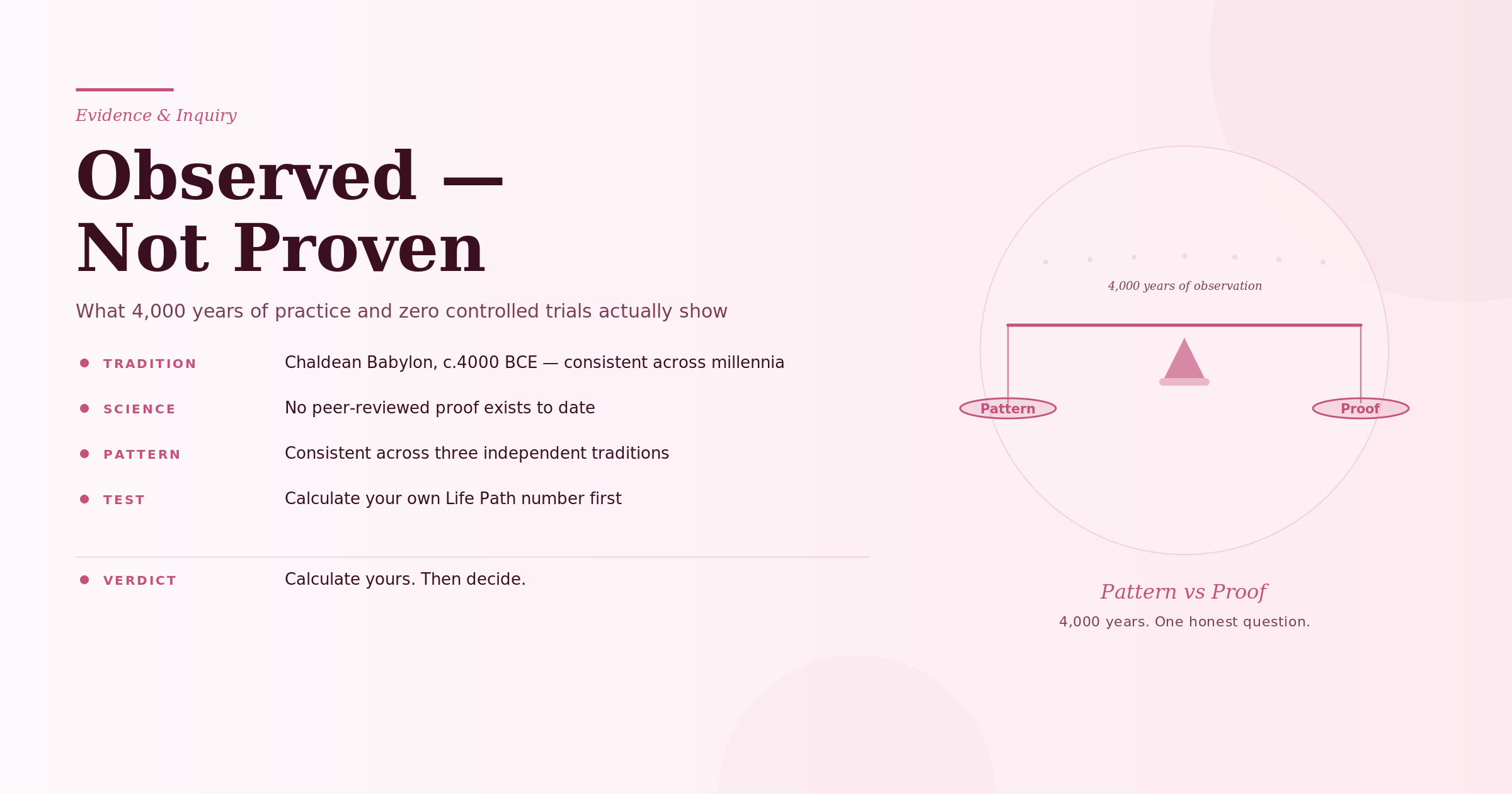
Before you can answer whether numerology is real, you need to decide which standard you're applying. There are three distinct ones, and they lead to very different conclusions.
Controlled scientific proof means double-blind trials demonstrating that a birth date causally produces specific personality traits. No such study exists for numerology. It has not cleared this bar, and practitioners who are being straight with you will say so without flinching.
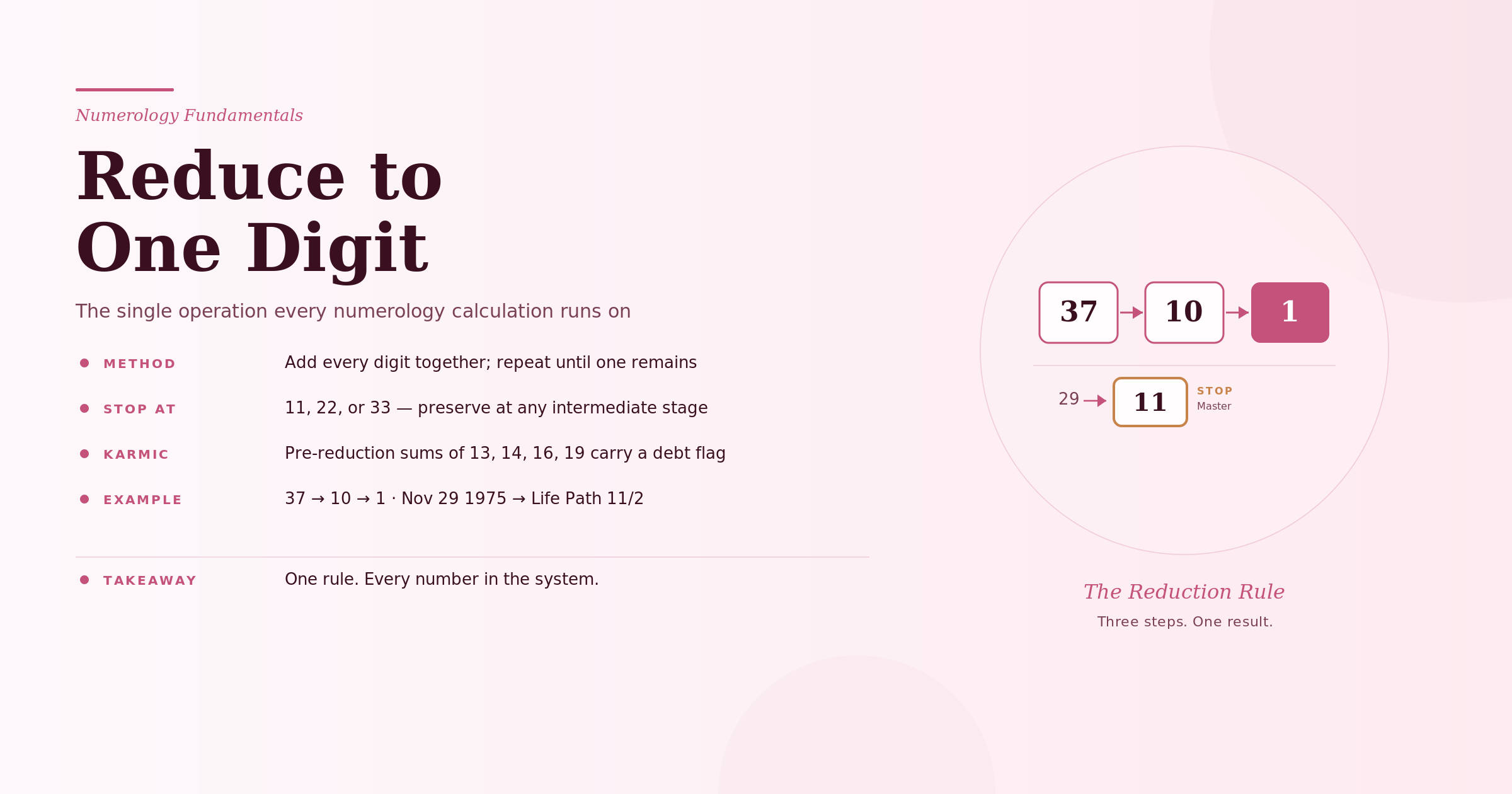
Observed pattern means consistent correlations between numbers and life themes across thousands of readings — correlations that practitioners encounter repeatedly, across clients who had no prior exposure to the system. Numerology has this in abundance. The practitioner working with 800 clients over a decade notices that Life Path 4 people describe the same core tensions without being prompted. That's not scientific proof, but it is data.
Symbolic framework means a coherent internal system that helps people reflect on their nature, timing, and relationships. Useful whether or not it maps onto physical reality. Therapy, narrative, philosophy, and art all operate here. So does numerology, at its best.
Most honest practitioners work at level two and three. The system makes no claim to be physics. Holding it to a physics standard, then declaring it failed, misunderstands what it's attempting.
What the Skeptic Says
The skeptical critique of numerology is worth taking seriously. Three objections come up most often, and each one is fair.
Cold reading is the practice of picking up social cues — age, dress, body language, phrasing — and reflecting them back as insight. A skilled reader can produce accurate-seeming statements about anyone without consulting any system at all. If a numerology reading happens live, face-to-face, some of what lands may be cold reading, not numbers.
Confirmation bias means we remember the times a system was right and forget or discount the times it was wrong. Humans are wired for pattern detection, sometimes at the cost of accuracy. A reading that's 40% accurate can feel 80% accurate if the hits were vivid.
The Barnum effect — named after P.T. Barnum, formalized by psychologist Bertram Forer — is the tendency to accept vague, flattering personality descriptions as personally accurate. "You have untapped potential you haven't fully explored" applies to nearly everyone. If a numerology description sounds like that, you're right to be skeptical.
A weak numerology reading looks exactly like all three of these. A strong one is specific: exact birth-date calculations, character meanings that explicitly don't apply to everyone, and timing predictions with clear windows that either happen or don't. That's the test.
What Practitioners Actually Observe
Practitioners who work with numerology seriously — across hundreds of clients, over years — notice something that's difficult to explain away as Barnum statements or cold reading.
The consistency of Life Path meanings is the most striking. People with Life Path 4 describe feeling an almost compulsive need for structure and stability before they've heard a word about what Life Path 4 means. People with Life Path 7 describe feeling like permanent outsiders even in groups that love them. These aren't descriptions they recognize as generally true of everyone — they recognize them as specifically, sometimes uncomfortably, true of themselves.
Personal Year cycles generate the other main line of evidence. The system predicts that certain years carry themes of new beginnings, consolidation, introspection, or major transition. Practitioners consistently hear clients say "that was the year everything changed" — and the year in question is a 1 Year or a 9 Year on their chart.
Sanjay Yadav, author of the reference book behind this site and the NumeroPro app, spent years cross-checking his own life events against his numerological cycles before building the system. City moves, career shifts, the year he married, relationships that ended, periods of stagnation — he tracked dozens of turning points and found alignment too consistent to attribute to chance alone. That's not a controlled experiment. But it is the kind of sustained personal observation that practitioners mean when they say the system works.
Pattern without a known mechanism is still pattern. Science has worked with unexplained correlations before — and some of them eventually got explained.
Illustrative — based on anecdotal practitioner surveys.
Illustrative — based on anecdotal practitioner surveys.
The Physics-Adjacent Argument
At the subatomic level, matter is not static. Particles are in constant motion. Sound moves as vibration within the range of roughly 20 to 20,000 Hz. Light travels as electromagnetic vibration. Color is frequency. Newton observed that the seven colors of the visible spectrum correspond to the seven notes of the musical scale — a structural parallel, not a physical law.
Numerology proposes an analogous principle: that the numbers 1 through 9 carry qualitatively different frequencies of expression — not in the measurable physics sense, but in the same way that a minor key carries different emotional qualities than a major one. We don't question whether the emotional difference between C major and C minor is "real." We accept it because we experience it directly.
This is a metaphor, not a measurement. A careful numerologist says so openly. Absence of a physical explanation does not constitute proof that no pattern exists. It means we don't yet understand the mechanism — which is a different claim.
The Practical Test You Can Run
The most direct way to evaluate numerology is not to read about it. It's to calculate your own Life Path number, read what the system says about it, and ask honestly: does this describe me?
Not in the Barnum way — "you sometimes feel misunderstood" fits almost everyone. Does it describe the specific tensions and gifts that show up in your actual life, the ones you've noticed across different contexts and relationships?
Do this without trying to confirm. Look for places where the description doesn't fit. That's the more rigorous test — and it's more interesting.
Here's a worked example. Born May 14, 1990:
Life Path Calculation — May 14, 1990
Life Path 11 carries the tension of high sensitivity and insight alongside a persistent pull toward self-doubt. If that lands for someone born on that date, they'll know it immediately — not because it's vague, but because it's specific in a way that most people never articulate about them.
Want to run the test? Calculate your Life Path, Expression, and Soul Urge numbers at the Tools section — then read the meanings and judge for yourself.
Common Questions
Has numerology been scientifically studied?
Some researchers — notably Michel Gauquelin in the 1950s through 1970s — found correlations between birth date and time and career outcomes, though his work was contested and never replicated to mainstream satisfaction. No study has specifically tested Pythagorean numerology under controlled conditions. The research simply hasn't been done at scale.
Is numerology a pseudoscience?
It doesn't claim to be science — it's a symbolic system with a 4,000-year empirical tradition. Calling it pseudoscience applies a scientific standard it never claimed to meet. That's like calling poetry pseudoscience because it doesn't run double-blind trials. The more honest framing is that numerology operates in a different category of knowing.
Does numerology conflict with religion?
Most practitioners find it compatible with personal faith. The system describes patterns in human nature — it doesn't claim to explain the divine, adjudicate theological questions, or replace prayer, scripture, or belief. Many people use it as one tool among several for self-understanding, alongside their existing spiritual practice.
Why do I keep seeing the same number?
Repeated numbers — 11:11, 222, 333 — may partly reflect heightened attention: once you notice a number, you register it more often than you register the dozens of other numbers you see daily (the frequency illusion, also called the Baader-Meinhof effect). Some numerologists read them as meaningful signals; others see them as pattern-recognition at work. Both perspectives are worth holding simultaneously rather than collapsing into either one.
Can I test numerology without believing in it first?
Yes — that's actually the most rigorous approach. Calculate your core numbers, read their meanings without predisposition, and notice which ones land with unexpected precision. Skeptical engagement is more useful than credulous engagement. You're less likely to manufacture meaning where none exists.
Numerology hasn't been proven in a laboratory, but neither has it been disproven — and four millennia of consistent use across cultures suggests something worth examining with an open and critical eye.
If this resonates and you want the full system in one place, the book Sort Your Life by the Numbers: A practical introduction to the art of numbers walks through it step by step.