

How to Reduce Any Number: The Core Rule of Numerology
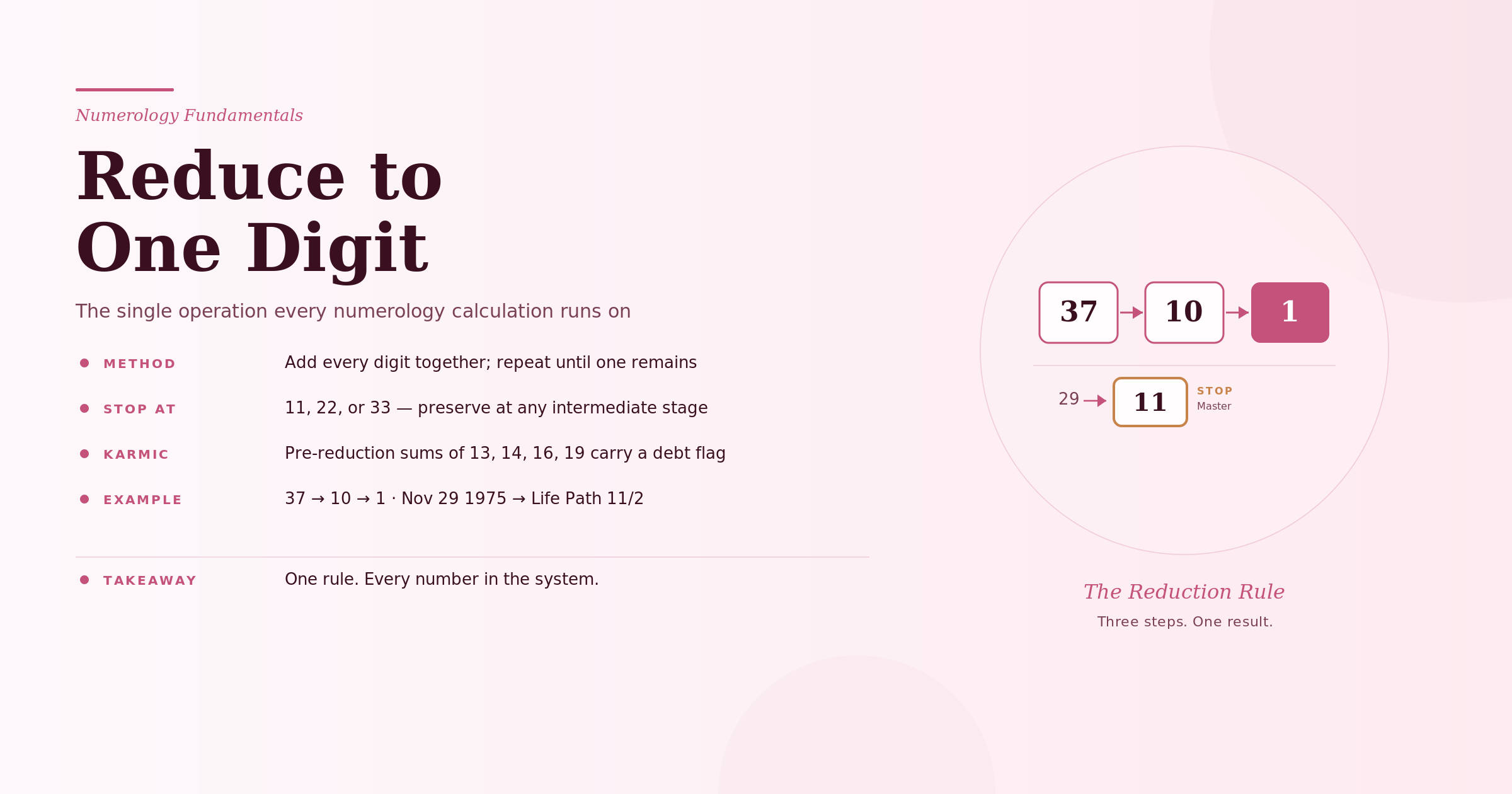
The single operation that underlies every number in your chartEvery number in numerology — your Life Path, your name value, your Personal Year — passes through the same filter. You add its digits together. If the result is still two digits, you add those. You keep going until you reach a single digit between 1 and 9. Three numbers, called Master Numbers, break this rule: when you reach 11, 22, or 33 at any point, you stop immediately and preserve them as they are. That is the whole rule. The rest of numerology builds on it.
The Rule in Plain Terms
Add the digits of any number together. If the result is still two digits, add those. Keep going until you reach a single digit — unless you hit 11, 22, or 33 at any point. Those three numbers stop immediately and are never reduced further.
What Digit Reduction Is
Numerology operates on the premise that every quantity, no matter how large, can be distilled into one of nine root energies — the numbers 1 through 9. Digit reduction is the mechanical process that achieves this. Take any number, sum its digits, repeat if needed, and you arrive at its essential character. The number 4,287 and the number 3 share the same root when 4+2+8+7=21 and 2+1=3. They occupy different positions on the scale of magnitude, but they pulse at the same fundamental frequency.
This applies across the entire system. Your birth date reduces to a Life Path number. The letters in your full name convert to digits that reduce to your Expression number. The current year reduces to a Universal Year number that sets the collective tone. Your house number reduces. A phone number reduces. The year a company was founded reduces. Every number you encounter can be brought back to its root, and that root is what numerology reads.
The three Master Numbers — 11, 22, and 33 — represent the one deliberate exception. These carry a doubled vibration that the system treats as irreducible: 11 is not simply 2, though 2 is its base; 22 is not simply 4; 33 is not simply 6. When they appear, the reduction stops there.
The Rule Shown Step by Step
The mechanics are straightforward. Start with any number, write out each digit, add them. If the result has two digits, treat those as your new number and add them again. Repeat until you land on a single digit. Here are three clear examples:
Example 1: 37
Example 2: 84
Example 3: 293
Each step is just addition. The only thing to watch for is whether your intermediate result is 11, 22, or 33 — if so, you stop before reducing further.
The Master Number Exception
The numbers 11, 22, and 33 occupy a different category. They are written in dual form — 11/2, 22/4, 33/6 — to signal both the master vibration and the base digit it rests on. The 11/2 has the cooperative, sensitive quality of the 2, but it operates at a higher register: heightened intuition, a pull toward idealism, a sensitivity that can feel both like a gift and a burden. The 22/4 builds on the practical steadiness of the 4 with an amplified ability to construct things of lasting consequence. The 33/6 extends the nurturing, responsible quality of the 6 toward a selfless compassion that is rare and demanding.
These three are never reduced to their base digit. More importantly, the check happens at every intermediate step — not just at the end. If you are adding the digits of a larger number and your running total passes through 11, 22, or 33, you stop at that point, even if there are more digits to process in a multi-stage calculation.
Master Number Examples
Notice that 49 passes through 13, which is not a Master Number. The chain continues to 4. This is a common point of confusion — only 11, 22, and 33 trigger the stop. Every other two-digit intermediate is just another step in the reduction.
The Karmic Debt Note
While not every compound number carries special weight, four of them carry what numerology calls a Karmic Debt signature: 13, 14, 16, and 19. When your pre-reduction sum lands on one of these exactly, the final single digit is noted in a combined form that records both the compound and the root.
The Karmic Debt numbers indicate specific patterns — tendencies toward rigidity (13/4), overindulgence (14/5), self-undoing (16/7), or self-reliance learned through isolation (19/1) — that the individual may encounter as repeated lessons. They do not change the final reduced digit, but they add a layer of context to what that digit means in your chart.
How to Identify a Karmic Debt
The compound number itself must be exactly 13, 14, 16, or 19 for the Karmic Debt to apply. Numbers like 25, 34, 43, and 52 all reduce to 7, but none of them carry the 16/7 Karmic Debt signature — only the number 16 does. The distinction is between what the number reduces through and what it is at the compound stage.
Worked Life Path Example: November 29, 1975
The Life Path number is calculated by reducing the birth month, birth day, and birth year separately — preserving any Master Numbers at each stage — then summing those three reduced values and reducing again.
This date yields three Master Numbers across all three components — an unusual concentration. The sum of 44 is not itself a Master Number, so it reduces normally to 8. The cross-check using the full unreduced figures (11 + 29 + 1975 = 2015, which reduces to 8) confirms the result. Both methods should always agree.
Want to calculate your own numbers? Head to the Tools section — your Life Path, Expression, and all your core numbers in seconds.
Go to the Tools SectionWhere Reduction Applies
Every number in the system passes through the same reduction rule. The Life Path is the most prominent — it is derived from the full birth date and describes the central trajectory of your life. But the rule applies equally to:
- Expression number — the total of all the digits in your full birth name, reduced to a single root.
- Soul Urge number — the vowels in your name converted to digits and reduced.
- Personality number — the consonants in your name converted and reduced.
- Personal Year number — your birth month and day added to the current calendar year, then reduced.
- Personal Month number — your Personal Year number added to the current month, then reduced.
- Pinnacles — four long-term cycle numbers, each derived by adding and reducing components of the birth date.
- Challenges — the differences between birth date components, reduced to single digits.
There is no number in the system that bypasses this rule. Once you have internalized the reduction process — including the Master Number check at every intermediate step — you have the foundation that makes every other calculation readable.
Distribution Across the Nine Root Digits
Among the first 100 positive integers, the nine root digits appear with roughly equal frequency — which is why no single digit dominates charts as a matter of statistical chance alone. The slight variations reflect the presence of Master Numbers (counted toward their base digit for this chart).
Illustrative count: how many of the first 100 positive integers reduce to each root digit.
Final single-digit results for numbers 1–100 — the distribution is roughly equal across all nine root digits.
Frequently Asked Questions
Does the order of addition matter?
No — addition is commutative. 37 and 73 both reduce to 1: 3+7=10 then 1+0=1, and 7+3=10 then 1+0=1. The digits can be summed in any sequence and the result is identical.
What about very large numbers?
Just keep summing. Take 98,741: 9+8+7+4+1=29, then 2+9=11. That is a Master Number — stop there. The size of the original number is irrelevant; the process is the same regardless of how many digits you start with.
Is 11 always preserved, or only in certain calculations?
Always, at any stage of any calculation — Life Path, name numbers, Personal Year, anywhere in the system. The moment an intermediate total reaches 11, 22, or 33, the reduction stops at that point.
What is the difference between 11 and 2?
The 2 is the practical base energy: cooperative, sensitive, and oriented toward partnership. The 11 carries amplified intuition, vision, and an intensity that the plain 2 does not. It is a more demanding frequency. Most people with an 11 in their chart operate at the 2 level most of the time, with the 11 energies surfacing in moments of heightened focus or stress.
Can a number reduce to 0?
No — 0 has no place in the 1 through 9 cycle. The only way to reach 0 as a digit sum would be from a number composed entirely of zeros, which does not arise in name or date calculations. Every real number you work with in numerology will reduce to something between 1 and 9, or stop at 11, 22, or 33.
If this resonates and you want the full system in one place, the book Sort Your Life by the Numbers: A practical introduction to the art of numbers walks through it step by step.