

How-To Guides — Sort Your Life by the Numbers
How to Calculate Your Expression Number From Your Name
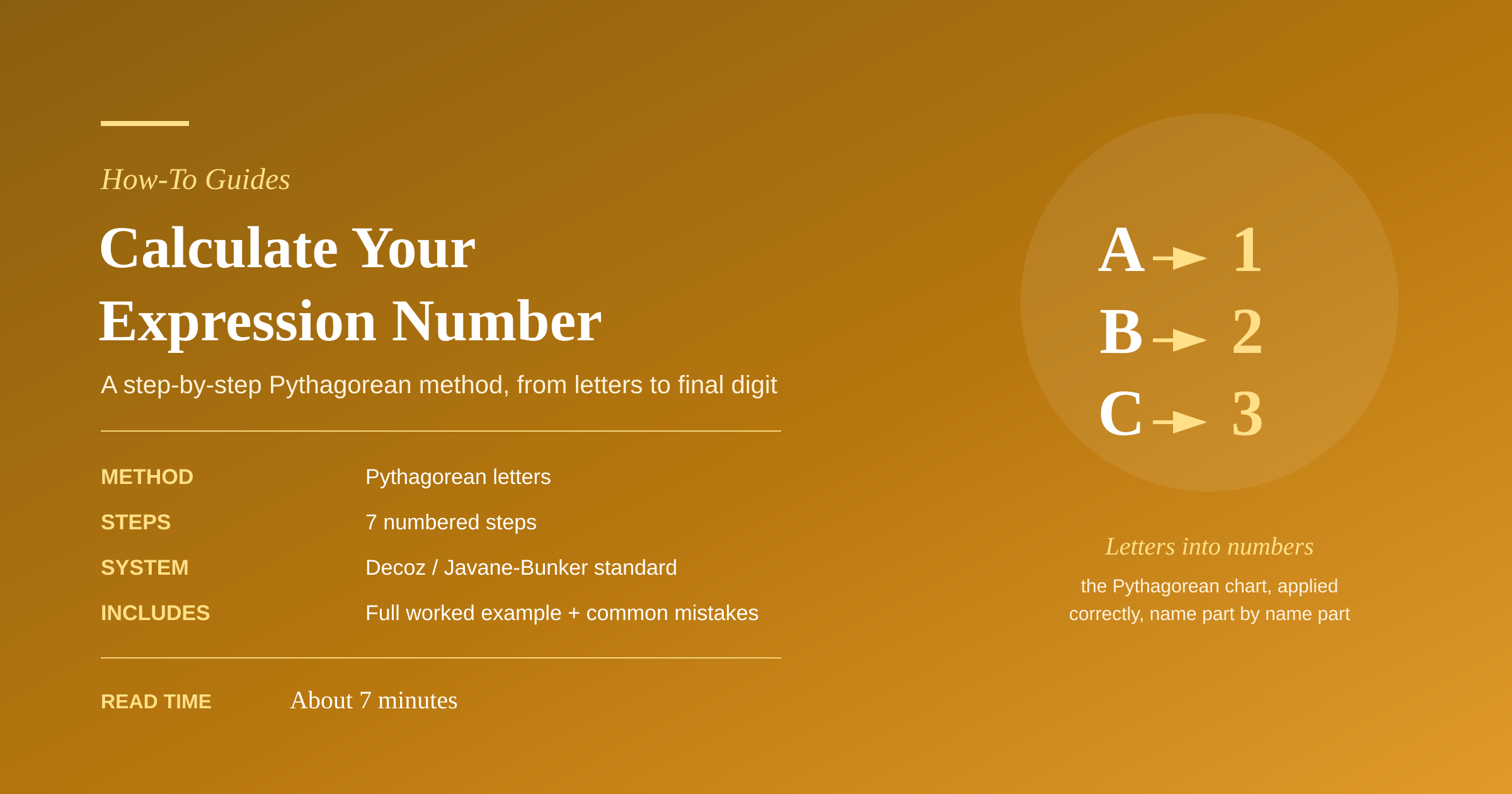
A clear, correct, step-by-step method for turning your full birth name into your Expression Number — with the letter chart, the exact math, and a worked example you can check against your own.
Your Expression Number comes from a straightforward calculation: convert every letter of your full birth name into a number using the Pythagorean chart, add the letters of your first name together and reduce that sum, do the same separately for each middle name and your last name, then add those name-part totals together and reduce once more. The only wrinkle is the Master Number exception — if a sum lands exactly on 11, 22, or 33 at any stage, you stop reducing and carry it forward whole. Get the order of operations right and the number falls out cleanly every time.
Quick answer: the letter values at a glance
What the Expression Number actually is
The Expression Number — some teachers call it the Destiny Number — is built entirely from the letters in your name, unlike your Life Path Number, which comes from your birth date. The idea behind it is that the name your parents gave you at birth carries a vibrational signature, and that signature describes the natural talents, working style, and mode of self-expression you arrived with. This article is not about what each result means — that's a separate piece for each number. Here, the job is narrower and more useful upfront: getting the calculation itself exactly right, because a single misstep in method (a nickname used instead of a birth name, letters added in the wrong grouping) changes the final digit and sends you reading the wrong description of yourself.
Why the calculation has to be done correctly
Numerology is a map, not a verdict, and a map only helps if you drew it accurately. People routinely calculate this number with a shortcut — adding every letter of the full name in one long pass — and get a different answer than the standard method produces. The gap isn't cosmetic. The standard method (detailed below) is built specifically to catch Master Numbers that appear inside a single name part, and a shortcut that skips the part-by-part reduction can miss one entirely. If you're going to sit with what this number tells you about how you're built to work and communicate, it's worth five extra minutes to compute it the way the tradition actually specifies.
The step-by-step method
This is the Decoz/Javane-Bunker standard, the version most Western Pythagorean numerologists teach and the one used consistently across professional readings. Follow it in order.
- Write out your full birth certificate name. First, middle, and last name, exactly as they appear on your original birth certificate — not a nickname, not a stage name, and not a name you took on later through marriage or legal change. Name = First + Middle(s) + Last
- Convert every letter of your first name to a number and add them. Use the Pythagorean chart above. Spaces and hyphens are skipped — they carry no value. FirstNameSum = value(letter 1) + value(letter 2) + … + value(letter n)
- Reduce that sum to a single digit, unless it's a Master Number. Add the digits of the sum together, and keep adding digits until one digit remains — unless at any point the number is exactly 11, 22, or 33, in which case you stop and keep it as-is. FirstNameTotal = reduce(FirstNameSum), where reduce(n) = n if n ∈ {11, 22, 33}, else digit-sum repeated
- Repeat steps 2 and 3 separately for each middle name. If you have two middle names, you'll do this twice, producing two separate totals. Do not combine middle names with the first or last name before reducing. MiddleNameTotal = reduce(sum of letter values in that middle name)
- Repeat steps 2 and 3 for your last name. Same process, same Master Number exception. LastNameTotal = reduce(sum of letter values in the last name)
- Add all the name-part totals together. First name total, plus every middle name total, plus last name total — added as whole numbers, including any Master Numbers you kept unreduced. GrandTotal = FirstNameTotal + MiddleNameTotal(s) + LastNameTotal
- Reduce the grand total to your Expression Number — checking for a Master Number one last time. If the grand total itself is 11, 22, or 33, that is your Expression Number, unreduced. Otherwise, reduce it to a single digit. ExpressionNumber = reduce(GrandTotal)
Want the full Pythagorean letter chart and a calculator in one place so you're not doing arithmetic by hand every time you check a name? It's worth bookmarking before you go further.
The full diagram: name to number
The Expression Number flow: split the name into parts, convert and sum each part's letters, reduce each part (watching for Master Numbers), combine the totals, then reduce once more for the final result.
Example — Oprah Gail Winfrey
Here is the method run in full on a real, well-documented full birth name: Oprah Gail Winfrey. Every letter is converted using the same Pythagorean chart from the top of this article.
Step 1 — First name: OPRAH
6 + 7 + 9 + 1 + 8 = 31 → 3 + 1 = 4. Not a Master Number, so OPRAH reduces to 4.
Step 2 — Middle name: GAIL
7 + 1 + 9 + 3 = 20 → 2 + 0 = 2. Not a Master Number, so GAIL reduces to 2.
Step 3 — Last name: WINFREY
5 + 9 + 5 + 6 + 9 + 5 + 7 = 46 → 4 + 6 = 10 → 1 + 0 = 1. Not a Master Number at any stage, so WINFREY reduces to 1.
Step 4 — Combine the name-part totals
First name total 4, middle name total 2, last name total 1. Grand total: 4 + 2 + 1 = 7. Seven is not 11, 22, or 33, so no further reduction is needed.
Oprah Gail Winfrey's Expression Number is 7
Checked a second way: adding every letter of the full name in a single pass (O-P-R-A-H-G-A-I-L-W-I-N-F-R-E-Y) gives 6+7+9+1+8+7+1+9+3+5+9+5+6+9+5+7 = 97, which reduces to 9+7=16, then 1+6=7. In this particular name, both the correct part-by-part method and the all-at-once shortcut land on the same final digit — which is exactly why the shortcut is so easy to trust by accident. The next section shows a name where the two methods disagree, and why that disagreement matters.
Common mistakes that change the result
Most calculation errors trace back to one of five habits. Watch for these specifically.
- Using a nickname or stage name. "Freddie" is not a birth name; the calculation belongs to the name on the birth certificate, full stop. A stage name can be studied separately as its own kind of name-energy, but it is not the Expression Number.
- Using a married name. A name adopted later in life describes a different layer of numerology entirely (some traditions read it as an added influence, not a replacement). The Expression Number always uses the birth name.
- Adding all the letters at once instead of reducing each name part separately. This is the mistake with the most hidden consequences. Consider an illustrative example: a middle name whose letters sum to exactly 22 — a Master Number — sitting inside a longer full name. Reduced on its own, that middle name correctly stays 22 and gets carried forward as a Master Number. But if you add every letter in the entire name together in one long pass before reducing anything, that 22 gets buried inside a much bigger number and reduced away with everything else, and you never learn a Master Number was there. The part-by-part method in this article exists specifically to prevent that loss.
- Forgetting to check the final grand total for a Master Number. People reduce each name part correctly, then forget to apply the same 11/22/33 check to the combined grand total before reducing it. The check applies at every single stage, not just within name parts.
- Assigning spaces or hyphens a value. They have none. A hyphenated last name is treated as one unbroken string of letters — you sum all its letters together as a single name part, you don't split it at the hyphen into two separate calculations.
Skip the arithmetic — calculate yours instantly.
Open the Expression Number CalculatorOnce you have your number
Your Expression Number is a starting point, not a label. Once you've calculated it correctly using your full birth name, the next step is understanding what that specific digit tends to describe — the working style, the natural strengths, the friction points — and reading it alongside your Life Path Number rather than in isolation. This piece was built to get the math right; the meaning of each result (1 through 9, and the Master Numbers 11, 22, and 33) is covered in the companion guide [related article — add URL], and the full calculator suite can cross-check your work and generate the fuller reading in one pass.
Frequently asked questions
Do I use my current legal name or my birth certificate name?
Your birth certificate name — first, middle, and last, exactly as originally recorded. Not a married name, not a legal name change, not a nickname or stage name. The Expression Number describes the imprint you arrived with.
What if I have two middle names, or none at all?
Calculate each name part separately, however many parts you have. Two middle names means two separate part-totals to add in at the end. No middle name means you simply add the first name and last name totals — the method itself doesn't change.
Do spaces and hyphens get a numeric value?
No. They're skipped entirely. A hyphenated last name is still one continuous name part — sum all its letters together before reducing, rather than splitting the calculation at the hyphen.
What exactly is a Master Number, and when do I stop reducing?
11, 22, and 33 are Master Numbers. If a name part's letter-sum lands exactly on one of them, stop reducing and carry it forward whole into the final addition. Check the grand total for the same three numbers before you reduce that too.
Why reduce each name part separately instead of adding every letter in one pass?
Separate reduction is what lets a Master Number hidden inside one name part surface at all. Add every letter of the full name together first, and a part-sum of 11, 22, or 33 gets folded into a bigger number and reduced away before you ever see it.
Does the order I calculate first, middle, and last name matter?
No — addition doesn't care about order, so the final sum comes out the same either way. What matters is that each part is summed and reduced independently before you combine the totals.
Can two very different names produce the same Expression Number?
Yes, often. There are only twelve possible final results (1 through 9, plus 11, 22, 33), so many names — even ones that look nothing alike — land on the same number.
Takeaway: Your Expression Number comes from your full birth certificate name, reduced part by part — first name, each middle name, last name — with a standing check for Master Numbers at every stage, including the final total. Skip a part-by-part reduction and you risk losing a Master Number inside the math. Get the method right first; the meaning means more once you trust the number underneath it.
If this resonates and you want the full system in one place, the book Sort Your Life by the Numbers: A practical introduction to the art of numbers walks through it step by step.