


Numerology Guides · Expression Numbers
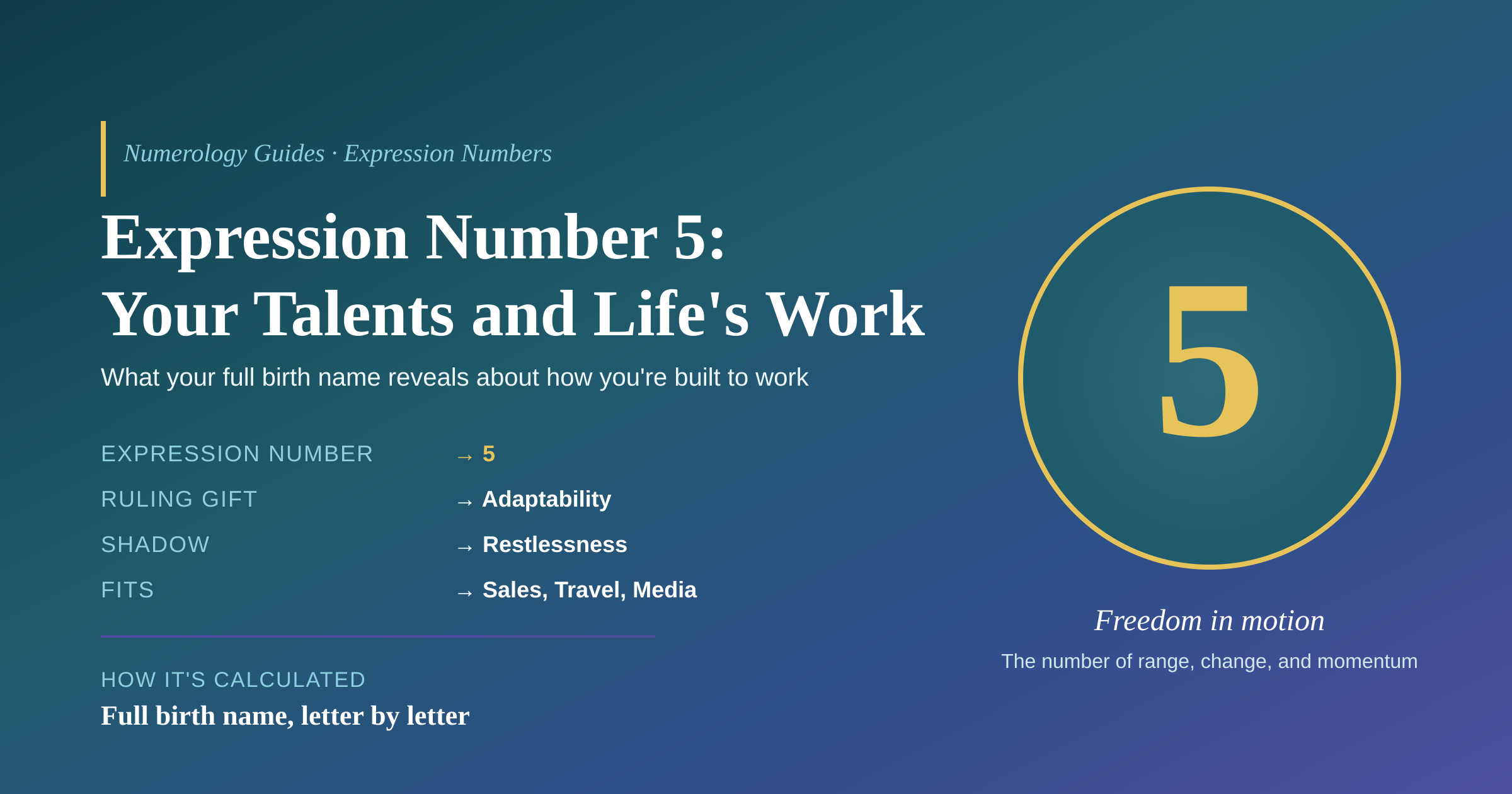
Expression Number 5: Your Talents and Life's Work
If your full birth name reduces to 5, your gifts were built for motion — read on to see exactly how that number is calculated and what it asks of you.
You already know the difference between a job that fits and one that just fits your resume. Expression Number 5 tells you which one you're built for, and it isn't the quiet, repeatable kind. This number comes from every letter in your full birth name, and when it lands on 5, it's naming a talent for range — the capacity to shift context, pick up new skills fast, and turn variety into an asset instead of a distraction.
Quick answer
Expression Number 5 means your full birth name reduces to 5, marking natural talents for adaptability, persuasion, and movement. It favors work built around change — sales, travel, journalism, marketing, entrepreneurship — over routine, and its shadow is restlessness: leaving things unfinished, or chasing stimulation past the point of usefulness.
What the Expression Number actually is
In Western Pythagorean numerology, the Expression Number (some call it the Destiny Number) is drawn from every letter of your full name at birth — first, middle, and last, exactly as it appears on the birth certificate. Not a nickname. Not a stage name. Not the name on your marriage license. The letters you were given at the start carry a numeric signature, and that signature describes your talents: what you're naturally equipped to do, and how you tend to do it.
This is different from your Life Path Number, which comes from your birth date and points to the lesson your life is organized around. Expression comes from your name, and it points to capability — the tools you showed up with. Think of Life Path as the terrain you're walking and Expression as the gear in your pack.
Why it matters for how you work
Most people don't choose careers by matching them to their actual wiring — they choose by proximity, by what paid first, by what a parent suggested. An Expression Number doesn't replace that decision-making, but it gives you a second opinion grounded in a consistent framework instead of a mood. If you're a 5, the honest question isn't "how do I get better at sitting still and following a script." It's "where can adaptability be the main event instead of a liability I have to manage."
How it's calculated — full worked example
The standard method (the Decoz/Javane-Bunker approach used across most modern numerology practice) converts every letter using the Pythagorean chart below, then sums and reduces each name part separately before combining them.
| 1 | 2 | 3 | 4 | 5 | 6 | 7 | 8 | 9 |
|---|---|---|---|---|---|---|---|---|
| A | B | C | D | E | F | G | H | I |
| J | K | L | M | N | O | P | Q | R |
| S | T | U | V | W | X | Y | Z |
Sum each letter's value in a name part, then reduce to a single digit — unless that total is 11, 22, or 33, a Master Number, which is left unreduced at that stage.
Example — the war correspondent Ernest Taylor Pyle (1900–1945), whose reporting on ordinary infantry soldiers in World War II earned him the Pulitzer Prize, gives a clean, documented Expression Number 5 from his full birth name.
| Name part | Letters & values | Sum | Reduced |
|---|---|---|---|
| ERNEST | E5 R9 N5 E5 S1 T2 | 27 | 2+7 = 9 |
| TAYLOR | T2 A1 Y7 L3 O6 R9 | 28 | 2+8=10 → 1+0 = 1 |
| PYLE | P7 Y7 L3 E5 | 22 | Master Number, kept as 22 |
First + middle + last, reduced: 9 + 1 + 22 = 32. Reduce the final sum: 3 + 2 = 5. Expression Number: 5.
Ernest, Taylor, and Pyle each reduce separately, then combine: 9 + 1 + 22 = 32 → Expression Number 5.
Skip the arithmetic and get your full Expression Number breakdown in seconds.
Open the Numerology ToolsWhat Expression Number 5 means
Digit 5 is the freedom number, and in the Expression position that freedom shows up as vocation rather than mood. You learn by doing, get bored by repetition faster than most, and tend to absorb new environments — new cities, new industries, new people — with a speed that looks like talent because it is one. Where a 4 wants a system to perfect, you want a landscape to cover. Where an 8 wants to build one structure taller, you want to be conversant in five different rooms.
That's not a lesser gift. It's a different one, and it's rare in a specific, useful way: most systems reward depth and punish breadth, so people with real range often talk themselves into narrowing before they've tested what the range is worth.
The gift
Adaptability that isn't just tolerance for change but actual fluency in it — you read a room, a market, or a new set of rules quickly, and you don't need everything mapped out before you act. That makes you valuable wherever conditions shift: new markets, new clients, new formats, new geography.
The shadow
Restlessness that mistakes discomfort for a signal to leave. Projects go unfinished, skills stay at "good enough," and commitments — to people, to routines, to your own health — get treated as optional the moment something more interesting shows up. Overindulgence rides along with this, since more is the default instinct.
Putting it to use
An Expression Number isn't a career sentence, but it is a filter worth applying honestly. If you're a 5 stuck in a role built entirely around fixed procedure and no variation, the friction you feel isn't laziness — it's a mismatch between the job's shape and your actual talent. That doesn't mean quit tomorrow. It means look for where the same skill set can operate inside more movement: a sales role instead of back-office processing, a beat that changes weekly instead of a single account, a business you can steer instead of a department you administer.
The discipline question for a 5 isn't "should I try new things" — you will, regardless. It's "what's the smallest number of commitments I keep long enough to actually get good at them." Range without any follow-through just produces a long list of almosts. Range with two or three things carried to real competence produces someone genuinely hard to replace.
If you want to see how your Expression Number interacts with your Life Path, Soul Urge, and other core numbers, run the full breakdown with the numerology calculator rather than guessing at the letter math by hand.
For a deeper look at how this number shows up across relationships and timing, see our related guide on Personal Year cycles [related article — add URL], and the companion piece on Life Path Number 5 [related article — add URL] if you want to compare how the same digit reads differently across the two positions.
Frequently asked questions
What is Expression Number 5 in numerology?
It's the destiny number that results when every letter of your full birth name reduces to 5. It describes natural talents for adaptability, persuasion, and movement rather than fixed routine.
Is Expression Number 5 the same as Life Path Number 5?
No. Life Path comes from your birth date and describes the lesson your life is built around. Expression comes from your full name and describes the talents you arrived with. The two can match or differ, and both are worth checking with the calculator tools.
How do you calculate an Expression Number?
Convert every letter of your full birth name using the Pythagorean chart, sum and reduce the first, middle, and last name separately, then add those three reduced totals and reduce the final sum — unless it lands on 11, 22, or 33.
What careers suit Expression Number 5?
Work with built-in variety tends to fit best: sales, travel and hospitality, journalism, marketing, and entrepreneurship. The common thread is range rewarded over routine.
What is the shadow side of Expression Number 5?
Restlessness — leaving things before mastery, chasing novelty past usefulness, and overindulgence in whatever form is available, from spending to substances to simply overcommitting.
Do married names or nicknames count toward Expression Number?
No. Standard practice uses the name exactly as recorded on the birth certificate — first, middle, and last at birth — not nicknames, stage names, or names adopted later through marriage.
Can a name total 11, 22, or 33 instead of reducing to 5?
Yes. Any name part or the final sum that lands exactly on 11, 22, or 33 is a Master Number and is typically kept unreduced at that stage, as shown with PYLE reducing to 22 in the worked example above.
Takeaway: Expression Number 5 names a talent for range — fast adaptation, comfort with change, and a working style built around movement rather than routine. Used honestly, it points you toward roles where that range is the asset, not the liability, and it asks you to pick a few things worth finishing instead of a hundred worth starting.
If this resonates and you want the full system in one place, the book Sort Your Life by the Numbers: A practical introduction to the art of numbers walks through it step by step.