

Expression Numbers
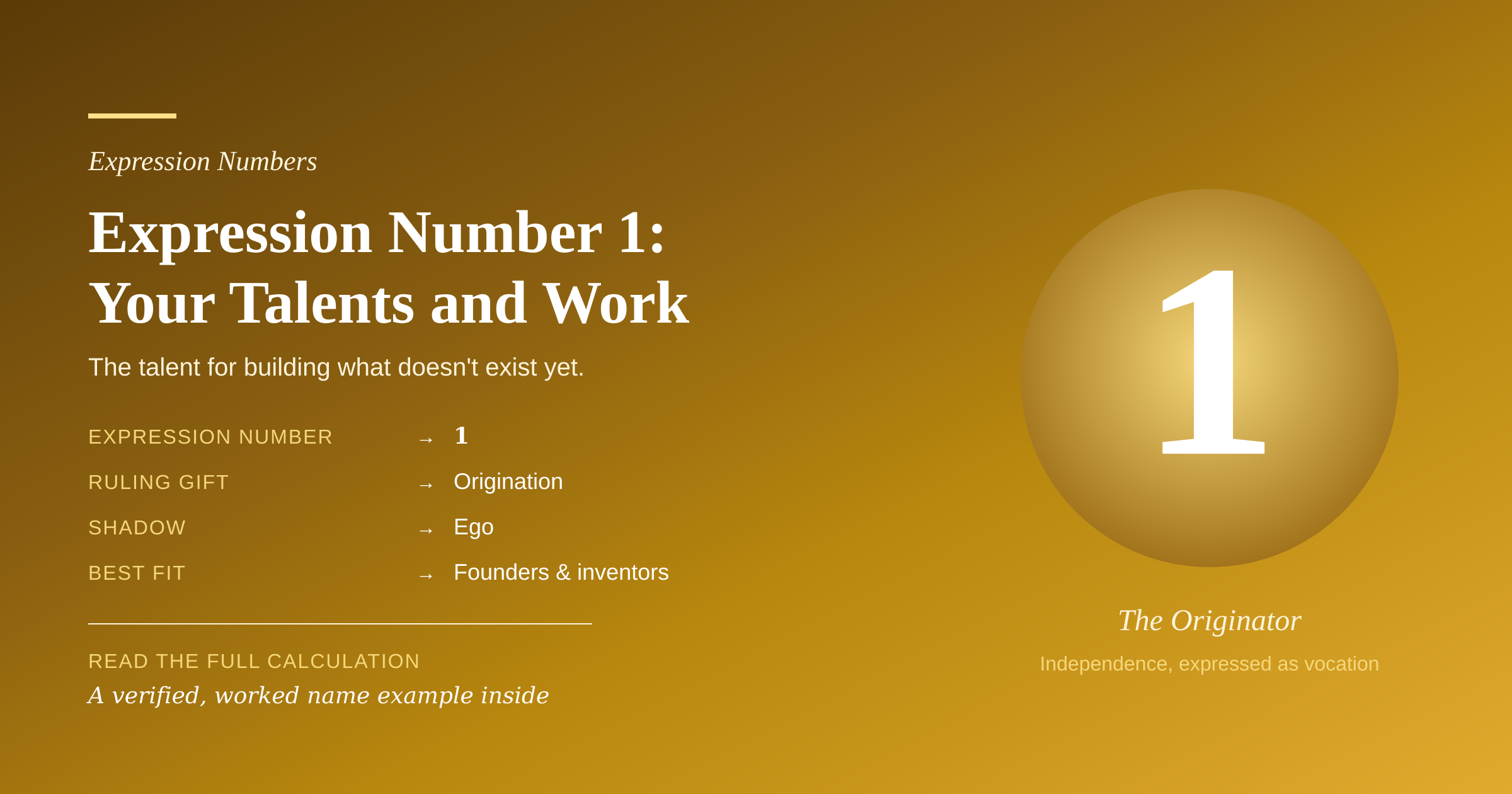
Expression Number 1: Your Talents and Life's Work
The number that shows up when every letter of your birth name points the same direction: go first.
If your Expression Number is 1, you were built to originate — to start what doesn't exist yet, lead it while it's fragile, and build something real where there was nothing before.
Quick answer
Expression Number 1 comes from the letters of your full birth name adding down to a 1. It describes a talent set organized around independence and initiative — the capacity to originate rather than follow a template. The gift is founding, inventing, and leading from the front. The shadow is difficulty sharing the work once it exists. This is different from your Life Path Number, which comes from your birth date and describes your overall direction, and different from your Birthday Number, which is a single narrow gift from the day you were born.
What the Expression Number Is
Your Expression Number — also called the Destiny Number in some traditions — comes from converting every letter of your full birth name into a number and reducing the result. Not your nickname, not the name on your business card, not a name you took later. The name on your original birth certificate: first, middle, last, every part of it. The idea behind this, going back to the Pythagorean tradition that modern numerology draws on, is that the name given to you at birth encodes something about the talents you arrived carrying.
That's what separates it from the two other numbers people most often confuse it with. Your Life Path Number comes from your birth date, not your name, and it describes the overall shape of your life's direction and the lessons built into it. Your Birthday Number is narrower still — it's just the day of the month you were born, reduced if needed, and it points to one specific built-in gift, almost like a bonus talent layered on top of everything else. The Expression Number sits between those in scope: it's about talent and vocation specifically — what you're equipped to do and build, not where your life as a whole is headed and not a single isolated gift.
Think of it this way: the Life Path is the terrain you're walking. The Expression Number is the tool belt you were handed before you set out. The Birthday Number is one extra tool tucked into a side pocket. All three matter, but if you want to know what kind of work will feel like yours — what kind of role will stop feeling like effort and start feeling like use — the Expression Number is the one to study.
Why It Matters
Most career dissatisfaction isn't a skills problem. It's a fit problem — smart, capable people doing work that's structurally wrong for the way they're built, and mistaking the resulting friction for personal failure. Knowing your Expression Number gives you a second reference point besides trial and error. It won't hand you a job title. It will tell you what kind of relationship to work suits you: whether you thrive originating something or perfecting something, leading alone or leading a room, building in public or building quietly. For a 1, that answer points hard in one direction, and ignoring it for years is usually where the friction comes from.
How It's Calculated — Full Worked Example
Here is the method exactly, using the Decoz/Javane-Bunker standard that most professional numerologists follow. First, the letter values:
| Value | Letters |
|---|---|
| 1 | A, J, S |
| 2 | B, K, T |
| 3 | C, L, U |
| 4 | D, M, V |
| 5 | E, N, W |
| 6 | F, O, X |
| 7 | G, P, Y |
| 8 | H, Q, Z |
| 9 | I, R |
The rule: convert every letter of the first name to its number and add them up, reducing that sum to a single digit — unless the sum lands on a Master Number (11, 22, or 33), in which case you leave it as is. Do the same, separately, for the middle name and the last name. Then add the three name-part totals together and reduce that final sum to a single digit, again watching for 11, 22, or 33 at the very last step.
Example — the real, documented birth name of Steven Paul Jobs (born February 24, 1955), co-founder of Apple. This is his full name exactly as recorded, not a stage name or a shortened version:
| Name Part | Letters & Values | Raw Sum | Reduced |
|---|---|---|---|
| Steven | S=1, T=2, E=5, V=4, E=5, N=5 | 22 | 22 (Master Number, held) |
| Paul | P=7, A=1, U=3, L=3 | 14 | 5 |
| Jobs | J=1, O=6, B=2, S=1 | 10 | 1 |
Add the three reduced part-totals together: 22 + 5 + 1 = 28. Reduce 28: 2 + 8 = 10, then 1 + 0 = 1. The final sum, 28, is not itself a Master Number, so it reduces all the way down — landing cleanly on Expression Number 1. Notice that "Steven" alone produces the Master Number 22 at the name-part stage; the rule says to hold that number unreduced through the addition and only check for Master Numbers again at the very last step, which is why the final answer still resolves to a clean single digit rather than staying a Master Number.
Steven Paul Jobs: three name parts, reduced separately (one held as Master Number 22), summed to 28, reduced to Expression Number 1.
Run your own full birth name through the calculation without doing the arithmetic by hand.
Open the Numerology ToolsWhat Expression Number 1 Means
The 1 is the number of origination. Where other Expression Numbers describe talents for refining, connecting, teaching, or sustaining what already exists, the 1 describes a talent for building the thing that didn't exist an hour ago. If you carry this number, you likely have an instinct for seeing a gap before anyone names it, and an equally strong instinct to move on that gap yourself rather than wait for permission or consensus. You don't need the whole path lit up in advance. You need enough light to take the next step, and you're comfortable being the one who takes it first.
This shows up as decisiveness that can look like impatience from the outside. You form a view quickly, commit to it, and expect to adjust course as you go rather than plan every contingency before you start. That's not recklessness — it's a different relationship with uncertainty than most people have. Where others need the plan finished before they'll move, you treat movement itself as part of the plan.
The gift
The core gift is the capacity to start — genuinely start, not just support someone else's start. You can look at nothing and see the outline of something. You can hold an idea that has no proof of concept yet and commit real effort to it anyway, because you trust your own read on what's possible. That combination of vision and nerve is rarer than it sounds, and it's the reason 1s so often end up as the first name attached to something: the founder, the inventor, the person whose name is on the patent or the company or the practice.
The shadow
The same wiring that makes you good at starting things makes you uneven at sharing them. Collaboration that requires waiting for slower input can feel like drag rather than diligence. Committees frustrate you. Consensus-building can feel like a detour from the actual work. And because so much of your identity gets wrapped up in having originated something, it's easy to underweight the people who helped you build it — not from malice, but because the origination itself feels like the part that mattered most to you. Left unchecked, that reads as ego, and it costs you the very collaborators a growing venture needs. The corrective isn't to stop leading. It's to notice when leading has quietly become taking, and to name other people's contributions as often as you'd want your own named.
Practical Use: Career and Vocation
An Expression Number of 1 doesn't require a founder title to matter. It shows up any time your role is to go first: the first person hired into a function who has to invent the process as they go, the solo practitioner who builds a client base from nothing rather than joining an established firm, the inventor working through prototypes long before there's a market. What all of those share is originality of structure — you're not optimizing an existing system, you're building the system.
Roles that tend to drain a 1 rather than use them well are usually the ones that reward maintaining over originating: highly standardized processes with no room to change the approach, environments where every decision needs sign-off from several layers above you, or work that's explicitly about executing someone else's already-finished vision indefinitely. None of that is beneath a 1 — it's just a mismatch, and mismatches are where burnout tends to start quietly.
If you're weighing a decision right now — take the safe role at an established company, or bet on the thing only you can see yet — the Expression Number won't make the decision for you, but it will tell you which choice is more likely to feel like use of your actual talent rather than management of your discomfort. For a 1, that's usually the harder, less certain option: the one where you're building rather than fitting in. You can cross-reference this against your full numerology chart to see how your Life Path and Expression Number reinforce or balance each other before you act on either alone. If you haven't already mapped your Life Path Number, [related article — add URL] walks through that calculation the same way this one does for Expression.
FAQ
What is the difference between Expression Number and Life Path Number?
The Life Path comes from your birth date and describes the overall direction and lessons of your life. The Expression Number comes from every letter of your full birth name and describes the talents you're built to use and the shape of the work you're here to do. They can match or differ, and both matter.
How do you calculate Expression Number 1?
Convert every letter of your first name to a number using the Pythagorean chart and sum them, reducing to a single digit unless the sum is a Master Number (11, 22, or 33). Repeat separately for your middle name(s) and last name. Add the three name-part totals together and reduce that final sum to a single digit, unless it lands on 11, 22, or 33. You can run this automatically using the numerology tools.
Does Expression Number 1 mean I have to be a boss?
No. It means your talent set is built for origination, not that a title is required. Plenty of Expression 1s do their most defining work as a solo practitioner, a first employee who shapes a department, or an inventor working alone in a workshop.
What is the shadow side of Expression Number 1?
Difficulty collaborating as an equal, impatience with slower processes or people, and a pull toward ego when credit isn't shared. The same drive that starts things can also make it hard to let others finish them.
Can I have Expression Number 1 and Life Path Number 1 at the same time?
Yes. When both numbers are 1, the theme of independent origination shows up in both your life direction and your natural talents, which tends to make the pull toward founding, inventing, or leading especially strong and hard to ignore.
Do I use my current name or my birth name for the Expression Number?
Use the exact name on your original birth certificate, including every middle name, not a nickname or a married name. The Expression Number describes the blueprint you arrived with, not the identity you go by day to day. Check your own full name with the calculation tools to be sure you're using the right letters.
What careers suit Expression Number 1?
Founders, entrepreneurs, inventors, solo practitioners, product creators, and anyone whose role requires going first — building a process, a company, or an invention where none existed before, rather than optimizing one that already does. If you want to see how this pairs with your Birthday Number, [related article — add URL] covers that calculation in detail.
Takeaway: Expression Number 1 is a talent for starting things that don't exist yet — and the discipline to keep sharing them once they do. Use the numerology tools to calculate your own full name and see where your instinct to originate is already trying to point you.
If this resonates and you want the full system in one place, the book Sort Your Life by the Numbers: A practical introduction to the art of numbers walks through it step by step.