
Numerology Fundamentals
Personality Number: The First Impression You Make
Before anyone reads your résumé, hears your story, or learns what you actually care about, they meet a surface. This number describes that surface — and what to do once you know what it's showing.
Your Personality Number is what a stranger clocks in the first ninety seconds: the posture, the tone, the thing about you that registers before a single fact does. It is not who you are underneath. It is not what you want. It is the doorway people walk through to get to you — and doorways shape what happens next, even when the room behind them is completely different.
Quick Answer
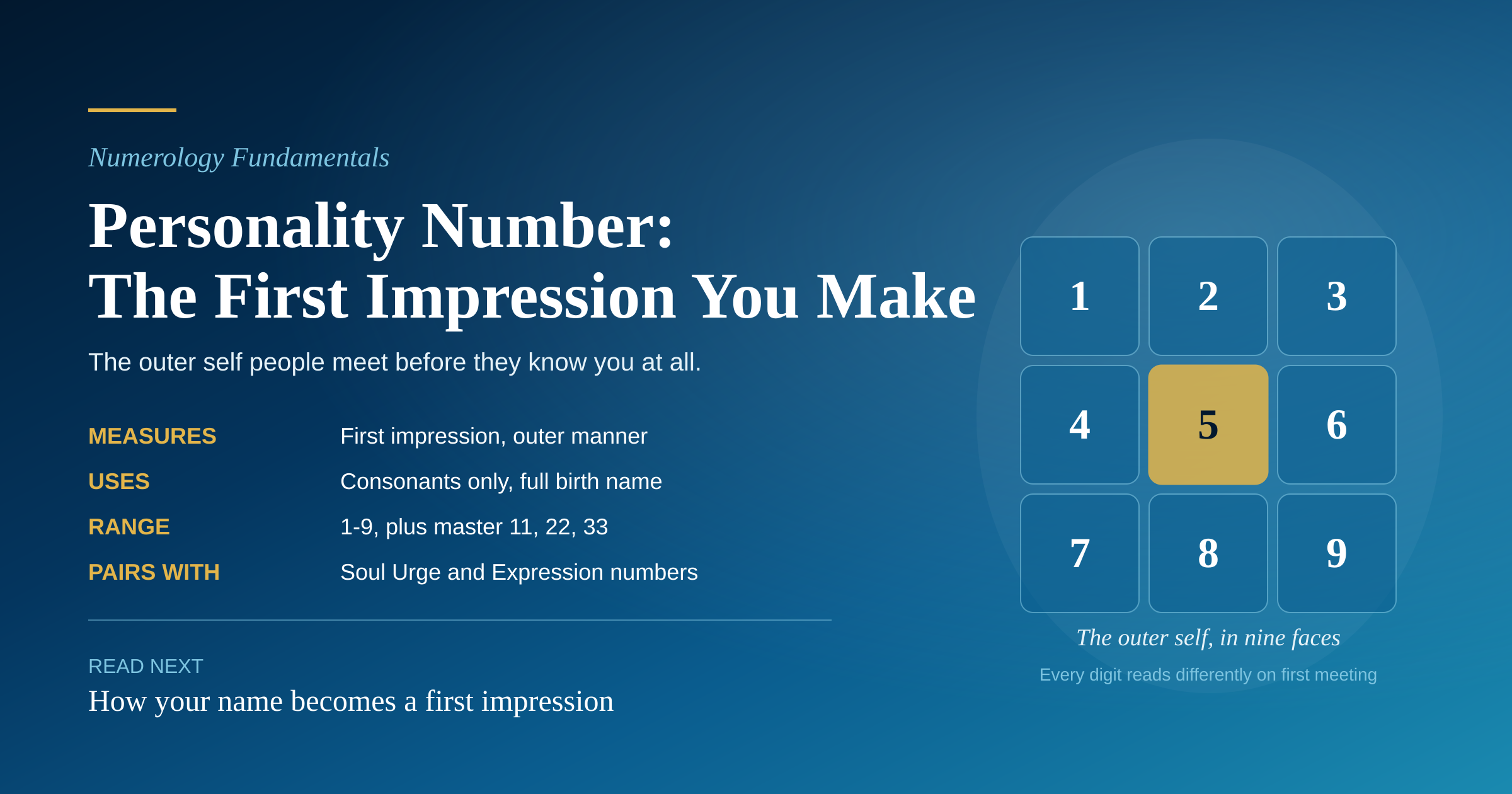
Your Personality Number is calculated from only the consonants in your full birth name and represents the outer impression you make before people know you well — distinct from your Soul Urge (inner craving, from vowels) and your Expression Number (full talent set, from every letter). It reduces to a single digit 1 through 9, or stays at a master number 11, 22, or 33.
What the Personality Number actually measures
Numerology treats your birth name as a kind of instrument, and different parts of it play different notes. The vowels carry your Soul Urge — the quiet want that drives you when no one's watching. Every letter combined gives you the Expression Number, the full instrument, the range of what you're capable of doing and becoming. The consonants alone give you the Personality Number: the resonance people catch from across the room, before they've heard you play a single full note.
This is why two people can share an Expression Number and still walk into a party completely differently. One reads as reserved and precise, the other as warm and expansive — because their Personality Numbers, built from a narrower slice of the same name, diverge. Neither impression is fake. It's just not the whole instrument. If you haven't run your own Expression Number yet, it's worth having both figures side by side before you read further.
Personality vs. Soul Urge vs. Expression — the short version
Think of it this way: Soul Urge is what you want, Expression is what you're built to do, and Personality is what shows up on the surface while the other two are still working themselves out. A useful way to hold all three at once is a quick side-by-side — or run all three through the free calculators and compare your own results directly.
| Number | Letters used | What it shows |
|---|---|---|
| Personality Number | Consonants only | The outer impression, first contact, surface manner |
| Soul Urge Number | Vowels only | The private inner craving, what you want most |
| Expression Number | Every letter | Your full talent set and life purpose |
Why it matters more than it looks like it should
People make decisions about you fast, and they rarely revise those decisions as quickly as they made them. A hiring manager forms an opinion in the first few minutes of an interview. A date decides, half-consciously, whether there's a second one before the appetizer arrives. Your Personality Number is the part of your chart that governs those early minutes — not because it's more important than your Expression or Soul Urge, but because it's the only one that's on display before anyone has earned the right to know the rest.
Knowing your own Personality Number lets you do something practical with it: stop fighting a surface that isn't going anywhere, and start using it on purpose. If your outer read is reserved and exacting, you don't need to fake extroversion in a room full of strangers — you need to let that precision open doors your warmth would take longer to open. If your outer read is magnetic and loud, you don't need to shrink it for a job that actually wants steadiness — you need to know when to let the shine rest. Not sure which digit you're working with yet? The Personality Number calculator takes less than a minute.
How it's calculated (condensed)
The full method lives in its own walkthrough — [related article — add URL] — but here's the shape of it. You take your full birth-certificate name, first, middle, and last, and keep only the consonants. Every letter that isn't A, E, I, O, or U is a consonant, with one exception: Y counts as a vowel when it makes a vowel sound (as in "Lynn") and a consonant when it makes a consonant sound (as in "Yolanda"). W is almost always a consonant, except in the rare case where it forms a true vowel pair.
Each surviving consonant gets a number from the Pythagorean chart:
- 1 = A, J, S
- 2 = B, K, T
- 3 = C, L, U
- 4 = D, M, V
- 5 = E, N, W
- 6 = F, O, X
- 7 = G, P, Y
- 8 = H, Q, Z
- 9 = I, R
You sum the consonant values within the first name and reduce to one digit — unless that sum lands exactly on 11, 22, or 33, a master number, which you leave alone. You do the same, separately, for the middle name(s) and for the last name. Then you add the three reduced totals together and reduce that combined sum the same way, again preserving a master number if one appears. The consonant identifier tool flags the Y and W edge cases automatically if you'd rather not track them by hand.
Example — Emma Charlotte Duerre Watson
This uses the actress's full birth name, a matter of public record, to show the method end to end.
| Name section | Consonants | Values | Sum | Reduced |
|---|---|---|---|---|
| First: EMMA | M, M | 4 + 4 | 8 | 8 |
| Middle: CHARLOTTE DUERRE | C,H,R,L,T,T / D,R,R | 3+8+9+3+2+2 / 4+9+9 | 27 + 22 = 49 | 4+9=13 → 1+3 = 4 |
| Last: WATSON | W, T, S, N | 5+2+1+5 | 13 | 1+3 = 4 |
Final step: 8 (first) + 4 (middle) + 4 (last) = 16 → 1 + 6 = 7. Her Personality Number is 7 — an outer read that tends to land as thoughtful, a little private, and unhurried in a first conversation, which tracks with the reserved, watchful presence she's often described as having on screen and off it.
Consonant extraction and reduction for the worked example above, ending in a Personality Number of 7.
Doing this by hand across three name sections is where most people make a small arithmetic slip. A calculator handles the consonant extraction and the master-number checks for you.
Try the Personality Number CalculatorThe twelve archetypes
Every digit reads differently on first meeting. None of these is a verdict — they're the tendency your consonants tend to project before anyone's had time to look closer. Full breakdowns of each digit, including career and relationship angles, live in their own dedicated articles. If you don't yet know your own number, the calculator takes it from your birth name in seconds so the archetype below actually applies to you.
A quick-reference grid of all twelve Personality Number archetypes, gift and shadow in one line each.
You come across decisive and self-assured before you've said much of substance — people tend to look to you first in a group. The shadow side is a read that lands as impatient or unwilling to listen. [related article — add URL]
You project a gentle, attentive presence that makes people feel immediately at ease and heard. Left unchecked, that same softness can read as indecisive or too eager to please. [related article — add URL]
You show up bright, expressive, and quick with words, the kind of presence that lifts a room's energy on entry. The flip side is a first read of flightiness, like there's no substance behind the sparkle. [related article — add URL]
You project steadiness and competence — people sense they can hand you something and it will get done. The cost is coming across rigid, humorless, or resistant before anyone sees your dry wit underneath.
You radiate curiosity and motion, the person people want to talk to because something interesting seems about to happen. That same energy can read as unreliable or unable to sit still with anyone.
You give off warmth immediately — people feel safe bringing you their problems within minutes of meeting you. The shadow is a presence that tips into meddling or a need to fix people who never asked.
You project quiet depth and a watchful intelligence, the sense that you're taking everything in before you speak. That same reserve can register as cold, unreadable, or hard to approach.
You come across polished, capable, and in command of the room, the person who seems like they already run something. The shadow is a read of coldness or unapproachable ambition before anyone sees the loyalty underneath.
You project a graceful, worldly warmth — people often say you seem wiser or older than your years within a single conversation. Left unchecked, that same quality reads as distant, like you're never fully in the room.
A master number outer read: you carry an intensity and radiance people notice immediately, almost electric. The shadow is coming across as too much, too fast — overwhelming before you've meant to be.
A master number outer read: you project rare, grounded capability, like you could organize the room and the plan behind it. The shadow is intimidating people out of offering help you actually need.
A master number outer read: you radiate devotion and generosity so immediately that people bring you their burdens on sight. The shadow is a presence so giving it erases your own needs from the room entirely.
Using it in real rooms — interviews, dating, networking
An interview is a Personality Number stress test. You have roughly the length of a handshake and the first answer to shift an impression that then colors how every later answer gets heard. If your number reads as reserved (7, for instance), over-performing enthusiasm you don't feel usually backfires — it's more effective to let your depth show through one sharp, specific answer than to fake energy you'll drop by minute ten. If your number reads as forceful (1 or 8), the move is often the opposite: naming a moment of collaboration early disarms the read of someone who only wants to run things.
Dating works the same way, just with different stakes. A first impression that leans intense (5, or the master numbers) can read as thrilling or exhausting depending entirely on pacing — the same person comes across completely differently on a slow walk than across a loud bar. Networking rewards knowing your number even more directly: a 4 or 7 in a room full of extroverted 3s and 5s isn't a disadvantage, it's a different kind of signal — the person who looks like they'll actually follow up.
None of this means performing a different self. It means understanding which parts of you arrive first, so you can decide whether to let them lead or to open with something else on purpose. Pair your Personality read with your Soul Urge and Expression results and you'll usually see exactly where the gap between "how I come across" and "who I actually am" sits.
Frequently asked questions
What is the Personality Number in numerology?
It's the outer impression you make on people before they truly know you — calculated from only the consonants of your full birth name. It describes surface manner, not inner motivation or talent.
How is the Personality Number calculated?
Convert every consonant in your first, middle, and last birth names to a number using the Pythagorean chart, sum and reduce each section separately (unless it's a master number), then add the three totals and reduce that final sum the same way. Use the calculator to skip the manual arithmetic.
What's the difference between Personality Number and Expression Number?
Expression uses every letter in your name and covers your full talent and purpose. Personality uses only consonants and covers the narrower slice strangers perceive on first contact.
What's the difference between Personality Number and Soul Urge Number?
Soul Urge uses only vowels and reveals your private inner craving. Personality uses consonants and reveals what other people see before they get that close.
Can my Personality Number be a master number like 11, 22, or 33?
Yes. If any stage of the calculation lands exactly on 11, 22, or 33, you keep that total unreduced, because master numbers carry their own distinct meaning.
Does the Personality Number change if I use a nickname?
No. It's calculated from the full name on your birth certificate, not a nickname or a legally changed name, because it tracks the identity you were given at birth.
Is the Personality Number a guarantee of how I'll come across?
It's a pattern, not a guarantee. It describes the tendency most likely to surface on first contact — in an interview, on a date, at an event — before your Expression and Soul Urge numbers have room to show themselves.
Takeaway: Your Personality Number is the doorway, not the house. It's worth knowing exactly what it projects — reserved or magnetic, steady or restless — so you can decide when to lead with it and when to let people wait for the fuller picture. For the exact calculation steps, see the how-to article at [related article — add URL], and for a full breakdown of your own digit, find its dedicated page at [related article — add URL].
If this resonates and you want the full system in one place, the book Sort Your Life by the Numbers: A practical introduction to the art of numbers walks through it step by step.