

How-To Guides
How to Calculate Your Personality Number From the Consonants
The math behind the first impression you make — step by step, with a fully verified example
Quick answer: Your Personality Number comes only from the consonants in your full birth name. Convert each consonant to its Pythagorean value (1–9), add the consonants within your first name, then your middle name(s), then your last name — separately. Reduce each name-part total to one digit unless it lands on 11, 22, or 33. Add the (possibly Master) totals together, then reduce that final sum the same way. That single digit, or Master Number, is your Personality Number.
Quick Reference: The Consonant Rule
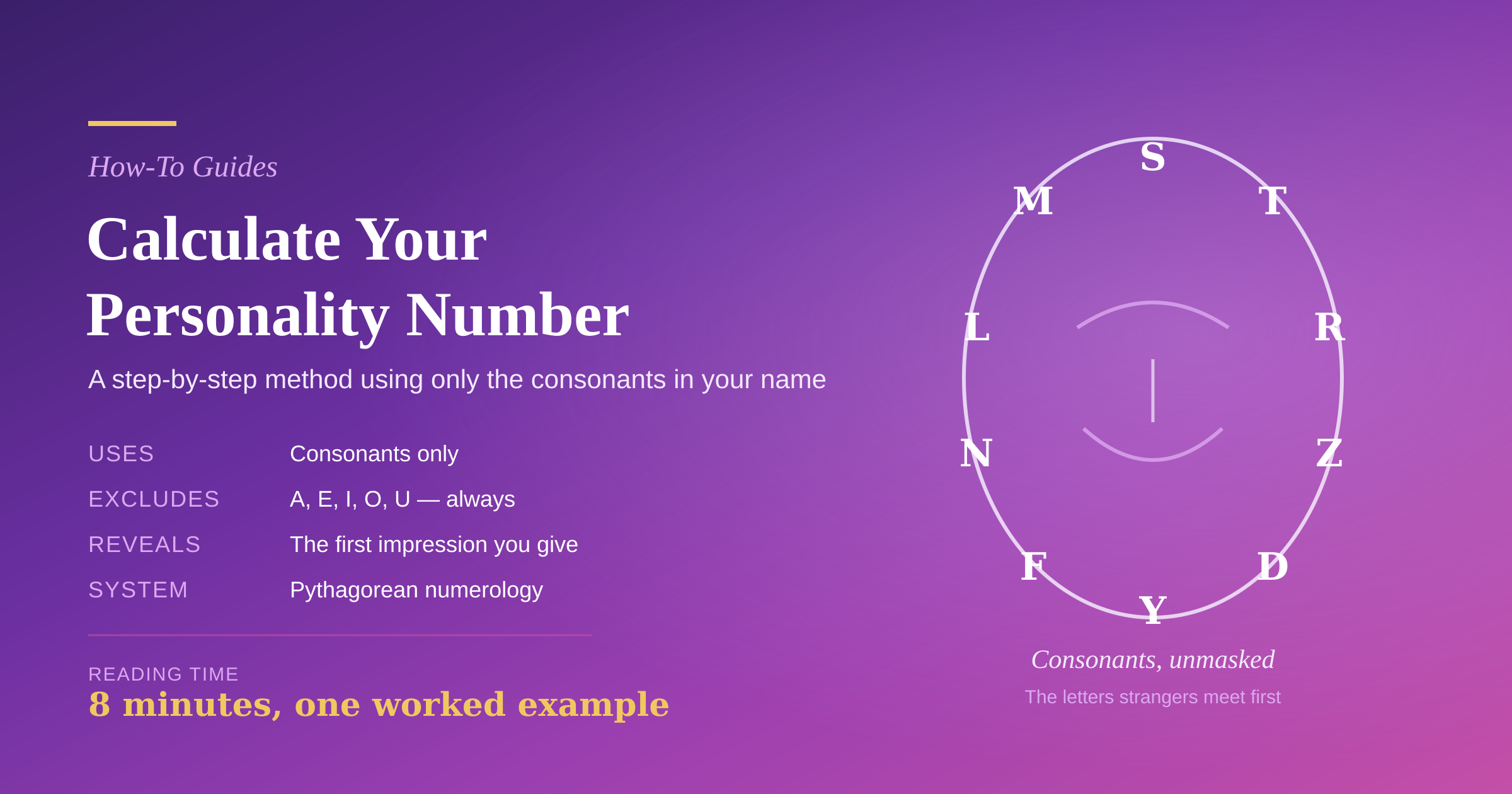
A consonant is any letter that is not a vowel. A, E, I, O, U are always vowels and always excluded. Y swings both ways: excluded when it sounds like a vowel (Sally, Amy), included when it sounds like a consonant (Yolanda, Yusuf). W stays a consonant almost every time.
1 A J S 2 B K T 3 C L U 4 D M V 5 E N W 6 F O X 7 G P Y 8 H Q Z 9 I R
What the Personality Number Actually Tells You
Think of your full birth name as carrying three separate signals. The vowels give you your Soul Urge Number — the craving underneath everything you do, the thing you want even when you don't say it out loud. Every letter together gives you your Expression Number — the full range of talent you were built with. The consonants, on their own, give you the Personality Number, and this one works differently from the other two. It's not about what you want or what you're capable of. It's about what a stranger picks up on in the first ninety seconds of meeting you, before you've said much of anything.
That distinction matters because people often confuse "personality" in numerology with "who I really am." It isn't that. It's the surface signal — the tone, the guardedness or warmth, the pace — that other people read off you before they know you. You can be a soft, sentimental person on the inside (a high Soul Urge in the emotional numbers) and still come across as clipped and businesslike on first contact, because your consonants are doing something different from your vowels. Both are true about you at once. That's the whole point of separating the calculation this way.
Why the Calculation Has to Be Exact
This isn't a number you can eyeball. A single misclassified letter — treating a vowel-sounding Y as a consonant, or working from a nickname instead of a birth certificate — changes the final digit, and a wrong digit means you're reading a description that was never yours to begin with. The Y rule alone trips up more people than everything else combined, because it's easy to remember "Y can go either way" and forget which way it goes for this specific number. We'll nail that down explicitly below, including how it flips for the Soul Urge Number, so you're not carrying two competing memories of the same rule.
The Step-by-Step Method
- Write your full birth name. First, middle, and last name, exactly as recorded on your birth certificate. Not a nickname, not a stage name, not a name you took on marriage.
- Cross out every vowel. Remove every A, E, I, O, and U from each name part. What's left is your working set of consonants.
- Apply the Y and W rules. For every Y, decide whether it's making a vowel sound (cross it out) or a consonant sound (keep it). Keep W as a consonant in virtually every case.
- Assign Pythagorean values. Give each remaining consonant its number from the chart above — 1 through 9, repeating across the alphabet.
- Sum each name part separately. Add the consonant values within your first name. Do the same, on their own, for your middle name(s) and your last name. Do not combine them yet.
- Reduce each name-part sum, watching for Master Numbers. Add the digits of each part's total together until you reach a single digit — unless that total is 11, 22, or 33, in which case you stop and keep the Master Number as is.
- Add the name-part totals together. Take the (possibly Master) result from each part and add them into one combined sum.
- Reduce the final sum. Reduce that combined sum to a single digit the same way, unless it is itself 11, 22, or 33 — in which case that Master Number is your finished Personality Number.
Example — Malala Yousafzai
To make the method concrete, here's a full worked example using a well-documented public name: Malala Yousafzai. Her name has two parts to work with — a first name and a last name — which makes a clean, checkable illustration of Method A. If your own name includes a middle name, you'd simply run this same process a third time for that middle part before the final addition.
Step 1 — First name: MALALA
Removing the vowels
M-A-L-A-L-A. The three A's are vowels and are excluded. What remains: M, L, L.
M = 4, L = 3, L = 3
Sum: 4 + 3 + 3 = 10 → reduce: 1 + 0 = 1
Step 2 — Last name: YOUSAFZAI
Removing the vowels and applying the Y rule
Y-O-U-S-A-F-Z-A-I. O, U, A, A, and I are vowels and are excluded. The Y here opens the word with a clear consonant sound (the "Y" in Yousafzai functions the same way it does in "Yolanda" or "you"), so it's included as a consonant. What remains: Y, S, F, Z.
Y = 7, S = 1, F = 6, Z = 8
Sum: 7 + 1 + 6 + 8 = 22 — this lands exactly on a Master Number, so it is not reduced. It stays as 22.
Step 3 — Combine and reduce
Adding the name-part totals
First name total: 1. Last name total: 22 (Master Number, carried forward as is).
1 + 22 = 23 → reduce: 2 + 3 = 5
23 is not itself 11, 22, or 33, so it reduces normally.
Final Personality Number: 5
Checked twice — once by hand, once by re-adding the consonant values independently — with the same result both times: 10 → 1, and 22 kept as a Master Number, summing to 23 → 5.
Diagram: the consonants-only path from Malala Yousafzai's birth name to a final Personality Number of 5, including the Master Number 22 held through the last step.
The Pythagorean Letter Value Chart
| Value | Letters |
|---|---|
| 1 | A, J, S |
| 2 | B, K, T |
| 3 | C, L, U |
| 4 | D, M, V |
| 5 | E, N, W |
| 6 | F, O, X |
| 7 | G, P, Y |
| 8 | H, Q, Z |
| 9 | I, R |
Common Mistakes That Change Your Result
Run your own full birth name through a checked calculator instead of doing the arithmetic by hand.
Open the Numerology ToolsWhat to Do With Your Personality Number
Once you have it, treat it as a description of your surface signal, not a verdict on your character. If your Personality Number runs cooler or more reserved than you feel on the inside, that gap is useful information — it tells you that people may need more time with you before they see what your Soul Urge or Expression Number actually points to. If you're building a public-facing role, meeting new people often, or working in sales, teaching, or leadership, knowing your Personality Number gives you a read on the gap between your first impression and your fuller self, so you can close it on purpose instead of leaving it to chance. You can check the full breakdown of what each Personality Number from 1 through 9, plus the Master Numbers, tends to mean using the numerology tools and reference charts on this site.
For a fuller picture, pair it with your Soul Urge Number and Expression Number — together the three describe what you crave, what you're capable of, and what people see first. [Related article — add URL: "How to Calculate Your Soul Urge Number From the Vowels"]
Frequently Asked Questions
Do I use my nickname or my full birth-certificate name?
Always your full birth-certificate name — first, middle, and last, exactly as recorded at birth. Nicknames, stage names, and married names change the letter count and will give you a different, incorrect result.
How does the Y rule work for the Personality Number?
Y is excluded (treated as a vowel) when it makes a vowel sound, like in Sally or Amy. Y is included (treated as a consonant) when it makes a consonant sound, like in Yolanda or Yusuf. This is the exact opposite inclusion pattern from the Soul Urge Number, which uses vowels — there, a vowel-sounding Y is included and a consonant-sounding Y is excluded.
What is the difference between the Personality Number and the Soul Urge Number?
The Personality Number uses only the consonants in your name and describes the first impression people form of you. The Soul Urge Number uses only the vowels and describes your inner craving — what you want beneath the surface. They are calculated from the same name but from opposite sets of letters. You can read the full method for the companion calculation using our vowel-based tools. [Related article — add URL: "Personality Number vs. Soul Urge Number: What's the Difference"]
Do I calculate the whole name at once or each part separately?
Calculate each name part separately. Sum the consonant values in your first name and reduce it, then do the same for your middle name(s) and your last name. Only after each part has its own reduced total do you add those totals together and reduce the final sum.
What happens if a name part adds up to 11, 22, or 33?
You leave it as that Master Number instead of reducing it further at that stage. You carry the Master Number into the final addition with the other name parts, and only then check whether the final total itself needs reducing or is also a Master Number, exactly like the 22 that appeared in Yousafzai above.
Is W always a consonant?
In the large majority of names, yes, W is treated as a consonant and included in the Personality Number calculation. It only shifts toward vowel treatment in the rare case where it forms a true vowel-pair sound rather than a distinct consonant sound.
Can two people with the same first impression number seem completely different?
Yes. The Personality Number describes the tone of a first impression, not the whole person. Two people sharing a Personality Number can have very different Life Path, Expression, or Soul Urge numbers, which shape how that first impression plays out over time. Use the full numerology toolkit to see how your other core numbers interact with this one.
Where can I double-check my arithmetic?
Work the sums by hand once, then run the same birth name through a verified numerology calculator as a second check — the same practice used for the Malala Yousafzai example above, which was confirmed two separate ways before being published here.
Takeaway: Your Personality Number is built entirely from the consonants in your full birth name — never vowels, never a nickname. Work each name part on its own, hold onto any Master Number you hit along the way, then add the parts and reduce once more at the end. Get the Y rule right, and the rest is just careful addition.
If this resonates and you want the full system in one place, the book Sort Your Life by the Numbers: A practical introduction to the art of numbers walks through it step by step.