
Personality Number 7: How the World First Sees You
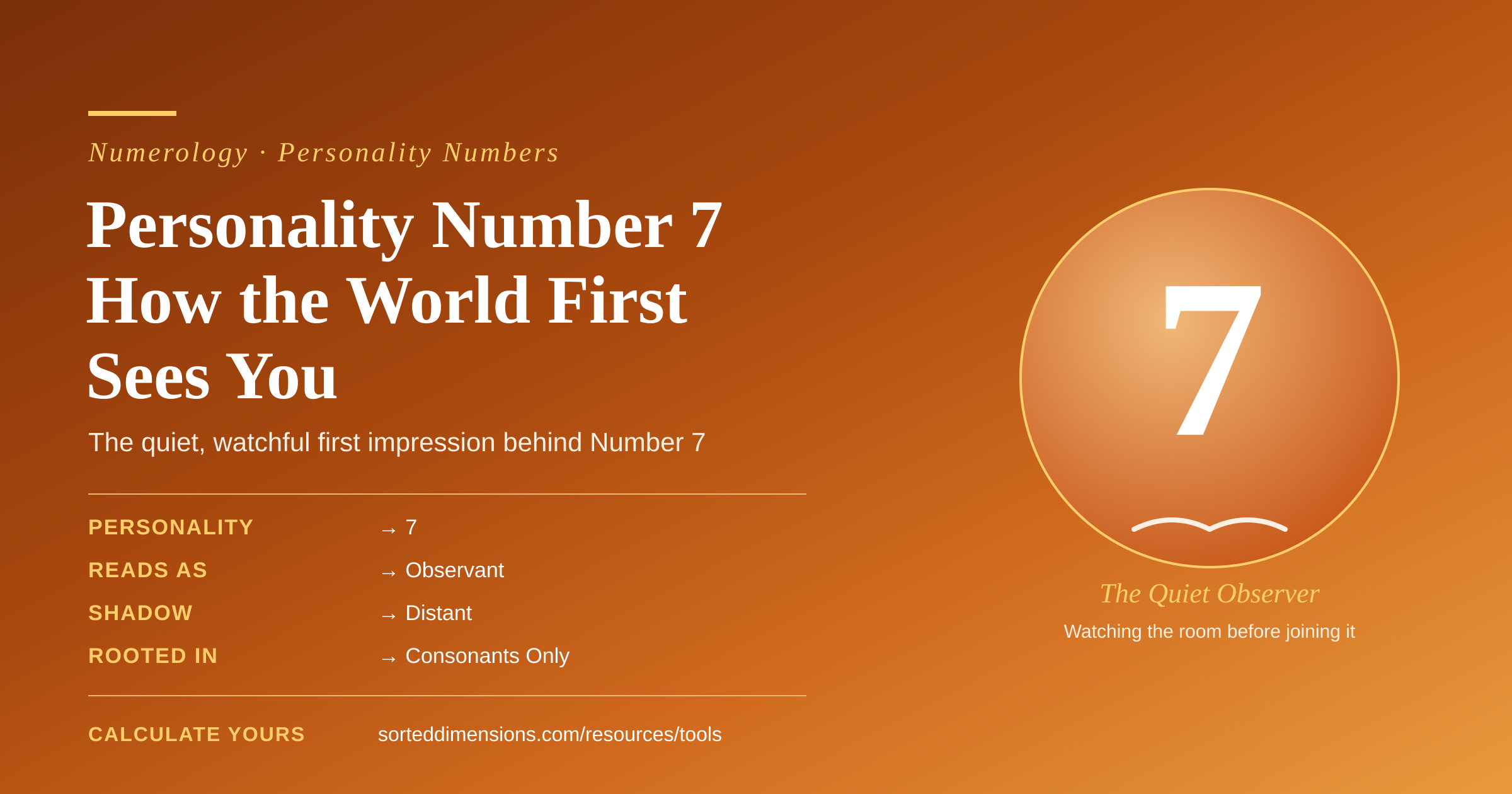
7Before anyone knows your story, they read your surface. A Personality Number 7 reads as watchful, quiet, and hard to rush — someone taking the room in before saying a word.
You walk into a room and, without saying anything, people already form a read on you. Somebody clocks your posture, your pace, the fact that you're listening more than talking. That instant read — before your résumé, your humor, your actual character ever gets a turn — is what numerology calls the Personality Number. If yours is 7, the read people get is quiet, observant, faintly guarded. You're the one studying the room while everyone else performs in it.
Direct answer: Personality Number 7 means you come across, on first meeting, as reserved and perceptive rather than expressive — someone who notices more than they say, which can be mistaken for distance even when you're simply taking things in before you commit to a response.
Quick answer
A Personality Number 7 first impression is quiet, watchful, and self-contained. People sense someone thinking rather than performing — a strength that reads as depth once trust builds, and as coldness before it does. It comes from the consonants only in your full birth name, not your birth date, and not your full name including vowels.
What the Personality Number actually is
Numerology gives you several different numbers because a person isn't one flat trait. Your Life Path Number comes from your birth date and maps your broader direction. Your Soul Urge Number comes from the vowels in your name and describes what you privately want. Your Expression Number uses your whole name and describes your full potential. The Personality Number is narrower and more specific than all of those: it's built only from the consonants in your birth name, and it describes exactly one thing — the impression you make on someone who doesn't know you yet.
Think of consonants as the outer shell of a word and vowels as its breath. In this tradition, vowels are treated as the inward-facing sound of the self — the part connected to the Soul Urge — while consonants are treated as the shape other people actually perceive. Strip away the vowels and you're left with the structural outline: the surface. That's why the Personality Number is sometimes called the "outer self" or the "mask" number, though mask undersells it — it isn't fake, it's just the part visible from a distance.
Why this number matters in practice
Job interviews, first dates, client pitches, a new team's first impression of you at the Monday meeting — these moments run almost entirely on Personality Number territory. You don't get to explain your Life Path Number to a hiring manager. They meet the surface first. Knowing your Personality Number gives you a name for the gap between how you intend to come across and how you actually land in those first ninety seconds, which is useful information whether you want to soften that gap or use it on purpose.
It also explains a common source of friction: being misjudged. A 7 who is genuinely warm can spend years being read as aloof simply because warmth, for this number, arrives on a delay. Naming the pattern doesn't erase it, but it gives you a way to plan around it — a beat of extra warmth up front, a deliberate question asked early, anything that signals engagement before the natural reserve reads as disinterest.
How the Personality Number is calculated
The method uses the Pythagorean letter chart, the same one used across Western numerology for Expression and Soul Urge numbers:
- 1 — A, J, S
- 2 — B, K, T
- 3 — C, L, U
- 4 — D, M, V
- 5 — E, N, W
- 6 — F, O, X
- 7 — G, P, Y
- 8 — H, Q, Z
- 9 — I, R
Every letter that isn't a vowel counts as a consonant. A, E, I, O, U are always excluded. Y is the one flexible letter: it's excluded (treated as a vowel) when it makes a vowel sound in that name, and included (treated as a consonant) when it makes a consonant sound. W is almost always a consonant, with rare exceptions in true vowel-pair sounds.
Once you've isolated the consonants, sum the values within the first name and reduce to a single digit — unless that part-sum happens to be 11, 22, or 33, a Master Number, which stays unreduced at that stage. Do the same separately for the middle name and the last name. Then add the three reduced totals together and reduce that final sum to a single digit, again holding onto 11, 22, or 33 if the final sum lands there.
Example — Franklin Delano Roosevelt
Franklin Delano Roosevelt, the 32nd President of the United States, is a fully documented public birth name, which makes it a clean way to show the math end to end.
| Name part | Consonants used | Values | Sum | Reduced |
|---|---|---|---|---|
| FRANKLIN | F, R, N, K, L, N | 6+9+5+2+3+5 | 30 | 3 |
| DELANO | D, L, N | 4+3+5 | 12 | 3 |
| ROOSEVELT | R, S, V, L, T | 9+1+4+3+2 | 19 | 1 |
Add the three reduced part-totals: 3 + 3 + 1 = 7. Because 7 is already a single digit and not a Master Number, no further reduction is needed. Franklin Delano Roosevelt's Personality Number is 7 — a documented, verifiable example of exactly the number this article covers.
Note on the letters: in FRANKLIN, the vowels A and I are dropped, leaving F-R-N-K-L-N as consonants. In DELANO, the vowels E, A, O are dropped, leaving D-L-N. In ROOSEVELT, the vowels O-O-E-E are dropped, leaving R-S-V-L-T. No Y appears in this name, so the vowel/consonant judgment call on Y doesn't come up here — worth flagging, since it's the step people usually get wrong.
Franklin Delano Roosevelt's consonants, summed by name part and reduced, add to a final Personality Number of 7.
Want to run your own full birth name through this exact method without doing the arithmetic by hand?
Open the Numerology ToolsWhat Personality Number 7 means for you
People who meet a 7 for the first time tend to describe the same thing in different words: quiet, watchful, hard to read, thoughtful, a little private. You're rarely the loudest person in the room, and that's not accidental — you're gathering information while everyone else is transmitting it. There's a natural instinct to hold back the first reaction, turn it over, and only then decide what's worth saying. To an outside observer, that pause reads as composure, sometimes as mystery, sometimes as coolness.
The gift in this is real: you notice what other people miss. Inconsistencies, undercurrents, the thing someone didn't say — a 7's radar for that is sharp precisely because so much attention is going outward rather than into performing. People who need a second opinion, a quiet sounding board, or someone who won't just agree to be agreeable tend to gravitate toward you once they've gotten past the initial reserve.
The gift
Depth on arrival. You clock details others walk past, and when you do speak, it tends to carry weight because it wasn't thrown out lightly. People eventually trust your read on a room precisely because you didn't rush to give one.
The shadow
Distance that isn't real. The same reserve that reads as thoughtful can just as easily read as cold, judgmental, or checked out — especially to people who equate warmth with immediate openness. Silence gets filled in by whoever's watching, and they don't always fill it in kindly.
Using this number in practice
Numerology works best as a decision map, not a verdict. If your Personality Number is 7, that first-impression gap is worth planning for rather than resenting. In situations where the stakes are high and time is short — interviews, first client calls, a blind date, a new team's first week — a small, deliberate gesture of warmth up front (a real question, a specific compliment, initiating rather than waiting to be drawn out) does a lot of work to bridge the gap between the read you're giving off and the person you actually are.
It's equally worth protecting the reserve itself. Not every room needs your full engagement in the first sixty seconds, and there's nothing to fix about taking a beat before speaking. The goal isn't to perform extroversion you don't have — it's knowing when the 7 read is working for you (a negotiation, a first meeting where you want to be underestimated) and when it's quietly costing you (a room where connection needs to happen fast). You can check how this number interacts with your other core numbers using the free calculators in the tools section, which is often where the fuller picture — Life Path, Expression, Soul Urge together — starts to make more sense than any single number alone.
If you want to go deeper on how first impressions interact with your Life Path Number, see [related article — add URL], and for a full breakdown of how the Soul Urge Number (the vowel-only counterpart to this one) shapes what you want beneath the surface, see [related article — add URL].
Frequently asked questions
What does Personality Number 7 mean?
It describes the first impression you give off, not your inner self. People tend to read a 7 presence as observant, reserved, and quietly perceptive — someone who watches before they speak. You can test your own using the numerology tools.
Is Personality Number 7 the same as Life Path 7?
No. Life Path comes from your birth date and describes your life's overall direction. Personality Number comes only from the consonants in your birth name and describes the surface impression you make on strangers.
How do you calculate the Personality Number?
Take the consonants only from your first, middle, and last birth names. Convert each to its Pythagorean value, sum and reduce each name part separately, then add the three totals and reduce that final sum — holding onto 11, 22, or 33 at any stage rather than reducing further. Run the numbers yourself with the calculator tools.
Why use only consonants for the Personality Number?
Vowels represent the inner self (the Soul Urge Number) in this tradition, while consonants represent the outer self shown to the world. Removing the vowels isolates that surface layer — the impression, not the interior.
Can Personality Number 7 change over time?
The number itself is fixed, since it's drawn from your birth-certificate name. What can shift is how much of that reserved, observant quality you let show — behavior is a choice even when the underlying number stays constant.
Is a Personality Number 7 shy or antisocial?
Not necessarily. The 7 impression is about pace and posture in first meetings — watching before engaging — not about avoiding people. Many 7s are warm once trust is established; the reserve is simply the entry point.
Does a nickname change my Personality Number?
No. The calculation uses your full legal birth name, not a nickname, married name, or stage name, because the birth name is the fixed reference point this system is built on. Confirm your own name's spelling and result with the tools page.
What if my middle name total or final total is 11, 22, or 33?
Keep it unreduced at that stage — those are Master Numbers and carry their own intensified meaning rather than collapsing to a single digit. Only reduce further if the sum lands on something else above 9.
If this resonates and you want the full system in one place, the book Sort Your Life by the Numbers: A practical introduction to the art of numbers walks through it step by step.