
Numerology, decoded
Personality Number 6: How the World First Sees You
The consonants in your birth name shape the impression you leave before you've said much of anything.
Meet someone with Personality Number 6 and within minutes you've noticed something: they asked if you wanted water, they remembered your allergy from a conversation three weeks back, they're already refilling the bread basket. That's not performance. It's the number showing up exactly where it lives — in the very first read a stranger gets of you.
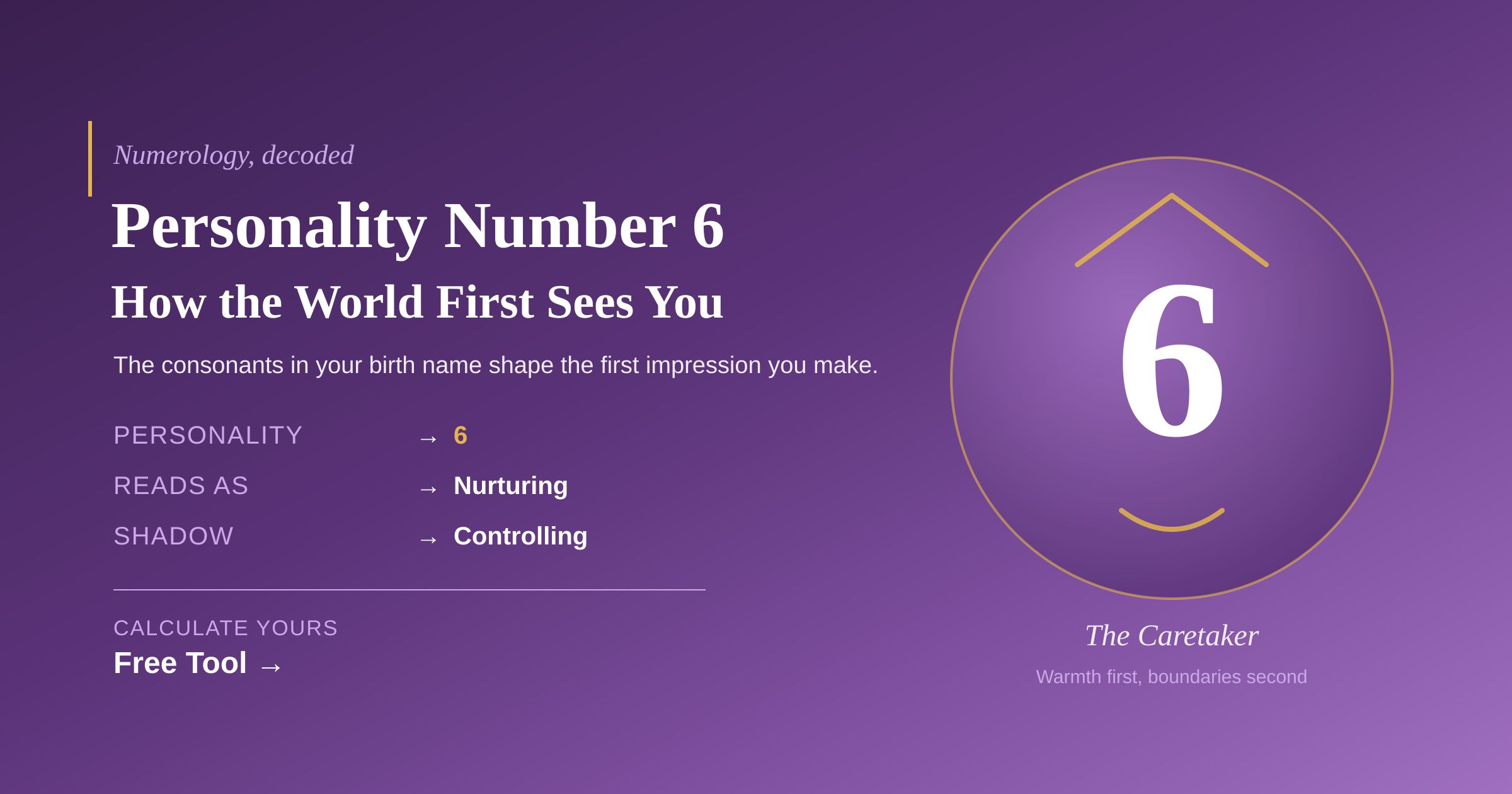
Personality Number 6 means people experience you, on first meeting, as warm, capable, and quietly in charge of everyone's comfort. It's calculated from only the consonants in your full birth name, and it describes the surface impression you make — not your deeper drives, which come from your Life Path or Soul Urge numbers.
What the Personality Number actually is
Numerology gives you several numbers built from your name and birth date, and each one answers a different question. Your Life Path Number, built from your birth date, describes the road you're on. Your Destiny Number, built from every letter in your full name, describes your larger purpose. Your Soul Urge Number, built from only the vowels, describes what you privately want. The Personality Number is the odd one out because it's built from only the consonants — the hard edges of your name, stripped of the softer vowel sounds.
That distinction isn't arbitrary. In the Pythagorean tradition this style of numerology comes from, vowels are treated as carrying the inner voice — what you feel and crave underneath — while consonants carry the outer shape, the version of you that reaches someone before your inner life does. Your Personality Number is, in effect, the number of your handshake, your tone of voice on a first call, the energy you give off in a waiting room.
Why it matters more than people expect
People make decisions about you — whether to trust you with a project, whether to open up, whether to hire you — well before they know your values or your history. The Personality Number names the pattern behind that snap judgment. If yours is 6, you probably don't have to work at seeming reliable and warm; it happens by default. The catch is that a number this easy to read is also easy to overuse. If your automatic setting is "take care of it," you can end up carrying things nobody asked you to carry, or hovering when someone actually wanted to be left alone. Knowing the number gives you a name for a pattern you're already running, so you can choose when to lean on it and when to dial it back.
How it's calculated — full worked example
The method uses the standard Pythagorean letter chart, where every letter maps to a digit from 1 to 9:
| Value | Letters |
|---|---|
| 1 | A, J, S |
| 2 | B, K, T |
| 3 | C, L, U |
| 4 | D, M, V |
| 5 | E, N, W |
| 6 | F, O, X |
| 7 | G, P, Y |
| 8 | H, Q, Z |
| 9 | I, R |
You strip out every vowel — A, E, I, O, U always go — and treat Y as a vowel or consonant depending on the sound it's making in that specific name. What's left in each name part gets converted to numbers, summed, and reduced to a single digit, unless that part's sum lands on a Master Number (11, 22, or 33), in which case it stays as-is until the very last step. You do this separately for the first name, the middle name(s) as one combined group, and the last name, then add the three results and reduce that final total the same way.
Example — Walter Elias Disney, the documented birth name of the animator and studio founder born December 5, 1901, in Chicago:
First name — WALTER. Consonants: W, L, T, R. Values: W=5, L=3, T=2, R=9. Sum: 5+3+2+9 = 19, which reduces to 1+9 = 10, then 1+0 = 1.
Middle name — ELIAS. Consonants: L, S. Values: L=3, S=1. Sum: 3+1 = 4.
Last name — DISNEY. The Y here closes out a long E sound ("DIZ-nee"), so it's functioning as a vowel and is excluded. Consonants: D, S, N. Values: D=4, S=1, N=5. Sum: 4+1+5 = 10, which reduces to 1+0 = 1.
Final total: 1 (Walter) + 4 (Elias) + 1 (Disney) = 6. The result already lands on a single digit with no further reduction needed. Personality Number: 6.
Consonants only, summed by name part, reduced, then combined — Walter Elias Disney's Personality Number resolves to 6.
Ready to calculate your own Personality Number without doing the arithmetic by hand?
Try the Free Numerology ToolsWhat Personality Number 6 means
Six is the caretaker's number, and it reads that way immediately. You come across as someone who notices comfort levels the way other people notice weather — automatically, without being asked to. In a group, you're often the one refilling glasses, checking that the quiet person in the corner is okay, or quietly picking up whatever task nobody claimed. People trust you fast because you look and sound like someone who follows through, and that instinct is usually earned rather than performed.
The shadow side lives right next to the gift, because it's the same trait pushed past its useful edge. The impulse to help can slide into an impulse to manage — deciding what someone else needs before they've said so, or feeling entitled to weigh in on choices that were never yours to make. Six can also read as a little too polished, too composed, as though the warmth has a schedule behind it. None of that makes the number "bad." It just means the gift needs a boundary attached, or it quietly turns into control dressed up as care.
How to use this in real life
If your Personality Number is 6, you can put it to work instead of just carrying it. In interviews or first meetings, trust that your presence already signals reliability — you don't need to oversell competence, because people read it off you before you finish a sentence. In relationships, watch for the moment concern turns into control: asking "do you want help with that?" costs you nothing and keeps the same warmth from curdling into pressure. At work, this number makes you a strong default choice for anything involving people management, client relationships, or team morale, precisely because you clock what others need without being told. The practical move is simple — let the gift lead, and build in a pause before the fixing instinct takes over.
It also helps to see this number next to the ones around it in your own chart. Pair your Personality Number with your Life Path and Destiny numbers using the free calculators to see whether your inner drive matches the caretaking impression you give off, or pulls in a different direction entirely — that gap, when it exists, is often the most useful thing to know about yourself.
Frequently asked questions
What is the Personality Number in numerology?
The Personality Number is calculated from only the consonants in your full birth name. It describes the outer impression you make on people who don't know you well yet, as opposed to your Life Path or Soul Urge numbers, which describe your inner drives.
How do you calculate a Personality Number?
Take the consonants only from your first name and convert each to a number using the Pythagorean chart, then reduce the sum to a single digit unless it lands on 11, 22, or 33. Repeat separately for your middle name(s) and your last name, then add the three totals and reduce that final sum the same way. Our free tools will run this for you automatically.
What does Personality Number 6 mean?
Personality Number 6 reads as warm, responsible, and family-oriented. People sense you'll notice what they need before they ask. The shadow side is that this same instinct can tip into over-involvement or a controlling need to manage other people's lives.
Is Personality Number 6 the same as Destiny Number 6?
No. The Destiny Number (sometimes called the Expression Number) uses every letter in your full name and describes your life's overall purpose. The Personality Number uses only consonants and describes surface-level first impressions. You can compare both with the calculators in our tools section.
Does a nickname change your Personality Number?
No. The calculation uses your full name exactly as it appears on your birth certificate, not a nickname, married name, or stage name, because the birth name is treated as your original numeric blueprint.
Is Y a vowel or a consonant in numerology?
It depends on the sound. Y is treated as a vowel when it makes a vowel sound, as in "Mary" or "Disney," and as a consonant when it makes a consonant sound, as in "Yolanda." This is one of the more common places people get the calculation wrong, so it's worth double-checking with the calculator rather than doing it from memory.
Can two people share a Personality Number 6 and still seem different?
Yes. The Personality Number only shapes the first layer people notice. Life Path, Destiny, and Soul Urge numbers shape everything underneath, so two Personality Number 6 people can feel quite different once you know them past the first impression. For a fuller picture of your own chart, see [related article — add URL] on reading your full numerology profile.
Where can I calculate my own Personality Number accurately?
Use a dedicated calculator rather than doing the consonant sorting by hand, since Y and compound surnames are easy to miscount. The SortedDimensions tools page has a free calculator built for exactly this, alongside calculators for your Life Path, Destiny, and Soul Urge numbers. You may also want to read [related article — add URL] to see how Personality Number 6 compares with its neighbors, 5 and 7.
Takeaway: Personality Number 6 means you walk into a room already read as someone who takes care of things — and the work isn't becoming more caring, it's learning when to let the caring stay a choice rather than a reflex.
If this resonates and you want the full system in one place, the book Sort Your Life by the Numbers: A practical introduction to the art of numbers walks through it step by step.