

First Impressions, By the Numbers
Personality Number 4: How the World First Sees You
Before anyone learns what drives you, they read your surface. If your Personality Number is 4, that surface reads as solid ground.
You walk into a room and something about you tells people they can relax. Not because you're loud or charming in an obvious way — because you seem like someone who won't disappear when things get complicated. That's the work of a Personality Number 4. It's not your whole story. It's the cover, and people judge books by it constantly.
Quick answer
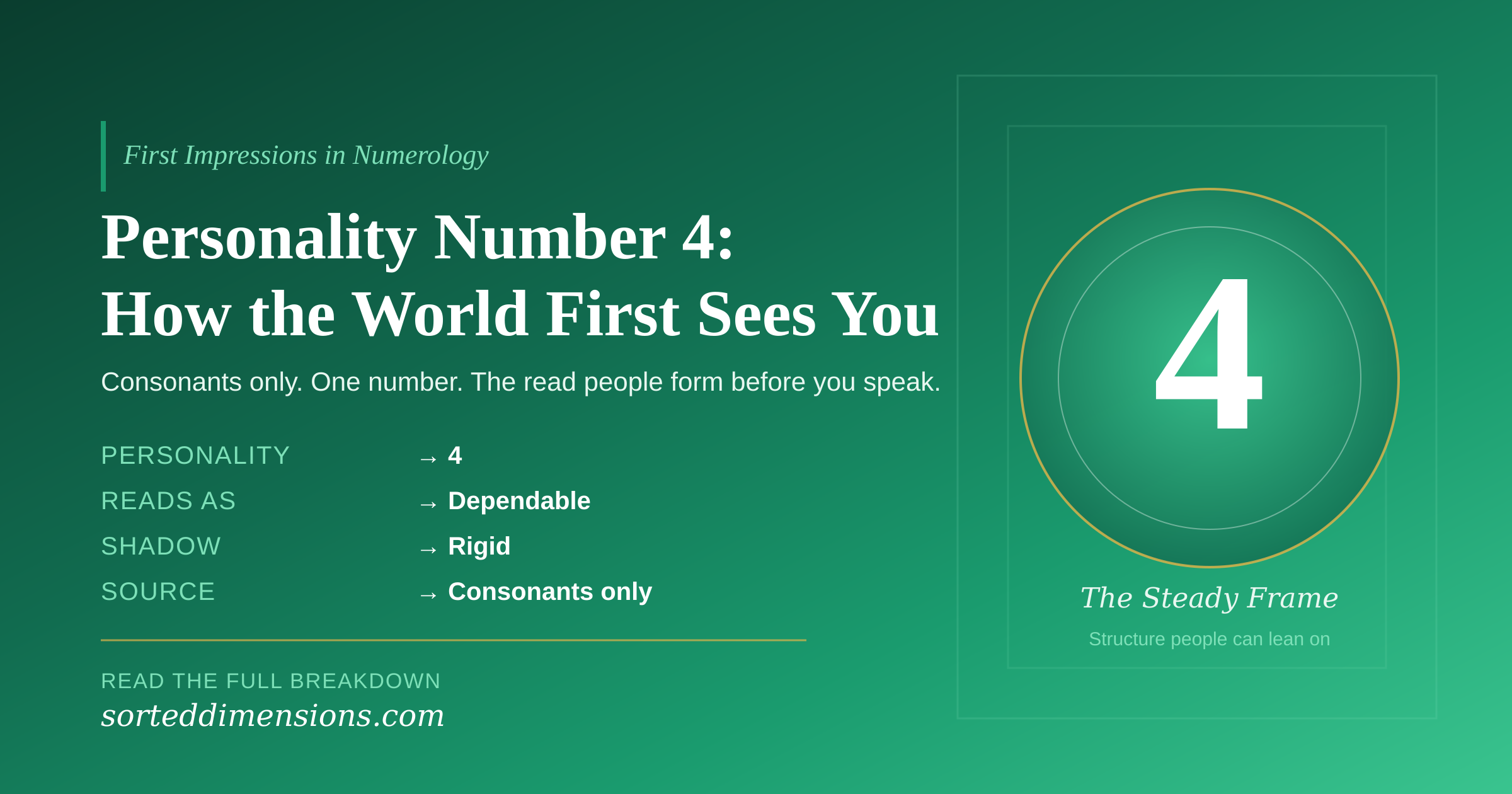
Personality Number 4 means new acquaintances experience you as grounded, practical, and dependable before you've said much of anything. It comes from the consonants in your full birth name, not your birth date, and it describes your outer impression rather than your inner drive.
What the Personality Number Actually Is
Numerology gives you more than one number because you are more than one thing at once. Your Life Path, built from your birth date, describes the terrain you're here to walk. Your Expression Number, built from your entire name, describes your natural capabilities. Your Soul Urge, built from the vowels in your name, describes what you privately want. The Personality Number takes what's left — the consonants — and uses them to describe something narrower and more immediate: the impression you make in the first few minutes, before anyone has evidence to go on.
Think of it as the part of you that shows up before you do. It's shaped by tone, posture, word choice, the pace at which you answer a question. People build a working theory of who you are from these signals, often within seconds, and that theory is remarkably hard to dislodge later. The Personality Number names the shape of that theory. If you haven't calculated your own yet, you can run your full name through the Personality Number calculator before reading further.
Why This Number Is Worth Knowing
Most people never separate how they come across from how they actually are. That gap is where a lot of quiet friction lives — the sense that people "don't get you," or that you keep getting cast in a role you didn't audition for. Understanding your Personality Number gives you language for the gap, and language is the first tool for closing it.
It also has practical use in ordinary decisions: how you open a difficult conversation, how you introduce yourself in a new job, how you read the space between what a first date says and what they project. None of this replaces judgment. It sharpens it. The full numerology toolkit can help you map this alongside your other core numbers so you're not reading the Personality Number in isolation.
How It's Calculated — Consonants Only
The method uses the Pythagorean letter system, the same one behind Expression and Soul Urge numbers, but applies it to a stripped-down version of your name — consonants only. Vowels (A, E, I, O, U) are excluded entirely, because they're reserved for the Soul Urge calculation. Y and W are usually consonants, but drop into vowel territory when they're making a vowel sound rather than a consonant sound in that particular name.
Here's the chart:
| Value | Letters |
|---|---|
| 1 | A, J, S |
| 2 | B, K, T |
| 3 | C, L, U |
| 4 | D, M, V |
| 5 | E, N, W |
| 6 | F, O, X |
| 7 | G, P, Y |
| 8 | H, Q, Z |
| 9 | I, R |
- Write your full name exactly as it appears on your birth certificate — first, middle, last.
- Cross out every vowel in each name part, leaving only consonants.
- Convert each remaining consonant to its Pythagorean value using the chart above.
- Add the consonant values within the first name and reduce to a single digit — unless the sum lands on 11, 22, or 33, in which case you leave it as a Master Number at this stage.
- Repeat step 4 separately for the middle name(s) and the last name.
- Add the three totals (or Master Numbers) together, then reduce that final sum to a single digit, again holding at 11, 22, or 33 if it lands there.
Example — Thomas Cruise Mapother IV
The actor known professionally as Tom Cruise was born Thomas Cruise Mapother IV. Numerology practice sets aside generational suffixes like "IV" and works from the given first, middle, and last names. Here's the full breakdown, consonants only:
THOMAS — consonants: T, H, M, S
T=2, H=8, M=4, S=1 → 2+8+4+1 = 15 → 1+5 = 6
CRUISE — consonants: C, R, S
C=3, R=9, S=1 → 3+9+1 = 13 → 1+3 = 4
MAPOTHER — consonants: M, P, T, H, R
M=4, P=7, T=2, H=8, R=9 → 4+7+2+8+9 = 30 → 3+0 = 3
Add the three reduced totals: 6 + 4 + 3 = 13 → 1+3 = 4. No stage touched 11, 22, or 33, so every reduction runs clean through to the final digit. That lands exactly on Personality Number 4 — consistent with how this name is cited across independent numerology profiles.
Figure: the consonants-only path from Thomas Cruise Mapother's three name parts to a final Personality Number of 4.
If your own name produces a different total, that's expected — the calculation is specific to your consonants, not a universal outcome. You can work it out by hand with the chart above, or run it through a dedicated calculator to double-check your arithmetic.
Run your own name through the full calculator suite — Personality, Expression, Soul Urge, and Life Path in one place.
Open the ToolsWhat Personality Number 4 Reads As
People meeting a 4 for the first time tend to relax without being able to say why. There's a steadiness in how you hold a conversation — you don't rush to fill silence, you don't overpromise, and your word tends to match your follow-through closely enough that people notice. If someone needs a task done right and on schedule, you're the one they think of first, often before they've seen much proof.
This reads as competence, and often it is. But it's also partly optics: a level voice, unhurried movements, a preference for concrete plans over vague enthusiasm. You come across less like someone selling an idea and more like someone quietly building the thing.
The Shadow Side
The same steadiness has an edge. Because you present as controlled, people sometimes wait for a signal before bringing up anything that isn't part of the plan — a joke, a personal problem, an idea with no clear use yet. You can come across as guarded even when you're simply thinking before speaking, and that gap between "careful" and "closed" is the one thing worth watching. Rigidity is the shadow of every strength this number carries: the same caution that makes you reliable can make you slow to welcome anything unscheduled.
None of this is a verdict. A first impression is a starting sketch, not a full portrait — useful information about the signal you're sending, not a ceiling on what you're capable of once someone knows you.
Using This Number in Real Decisions
If your Personality Number is 4, a few adjustments tend to pay off in daily interactions. In a first meeting where you want to seem more approachable, deliberately loosen the pace — ask a genuine question before getting to the agenda. In hiring, dating, or any situation where you're the one reading someone else, remember that a 4-style first impression can hide someone genuinely warm underneath; give the relationship more than one meeting before deciding who they are.
If you manage people, this number also explains why colleagues bring you the practical questions and save the messy, half-formed ones for someone else. That can be useful — you become the person who gets things finished — but it's worth occasionally signaling that you're open to the unfinished, uncertain stuff too, not just the plan that's already solid. Comparing your Personality Number against your Expression and Soul Urge numbers in the tools section will show you exactly where the outer impression and the inner motivation line up, and where they don't.
For a deeper comparison of how Personality Number 4 interacts with a 4 Life Path versus other Life Path numbers, see [related article — add URL]. And if you want to see how this number shifts across the full 1–9 range plus Master Numbers, the comparison guide is here: [related article — add URL].
Frequently Asked Questions
What does Personality Number 4 mean?
It means people read you as grounded and dependable within the first few minutes of meeting you. It describes the outer impression you give off, not your inner motivation or your life direction — you come across as practical, steady, and unlikely to flake.
How is the Personality Number calculated?
Take only the consonants from your full birth-certificate name. Convert each consonant to its Pythagorean value, sum the consonants in your first name and reduce, do the same separately for your middle and last names, then add the three totals together and reduce that sum to a single digit — unless a stage lands on 11, 22, or 33.
Is Personality Number 4 the same as Life Path Number 4?
No. Life Path comes from your birth date and describes your overall direction and lessons. Personality Number comes from the consonants in your name and describes only the surface impression people form before they know you well. You can learn more about how the two numbers interact using the calculators at sorteddimensions.com/resources/tools.
Why does the Personality Number only use consonants?
In this branch of numerology, vowels are said to reveal the Soul Urge — your private motivation — while consonants reveal the Personality, the outward face you present. Splitting the name this way is what separates the inner reading from the outer one.
Can my Personality Number change if I change my name?
Traditional practice calculates it from the full name on your original birth certificate, since that's the name your identity first formed around. Some practitioners will also chart a current legal name as a secondary, evolving read — you can test both versions using the name calculators here.
What is the shadow side of Personality Number 4?
The dependable, grounded quality can tip into rigidity or over-caution in first impressions. People may read you as closed off, or feel they need permission before raising anything outside the plan, even when you're simply being careful.
Does a Master Number change how Personality Number 4 is calculated?
Yes. If the consonant sum for a name part lands on 11, 22, or 33, that part isn't reduced further at that stage. Only after the three name-part totals are added together do you reduce the grand total to a single digit — unless it, too, is 11, 22, or 33.
Can two people share a Personality Number but seem completely different?
Yes, easily. The Personality Number describes one layer of first impression, not the whole person. Life Path, Expression, and Soul Urge all shape the fuller picture — run your complete chart with the full tool set to see how the layers combine.
Takeaway: Personality Number 4 is the sketch people draw of you before they have the full portrait — grounded, dependable, and, if you let it calcify, a little too guarded to invite the unplanned. Know the sketch, and you get to decide how much of it is the whole truth.
If this resonates and you want the full system in one place, the book Sort Your Life by the Numbers: A practical introduction to the art of numbers walks through it step by step.