
Numerology, decoded
Personality Number 3: How the World First Sees You
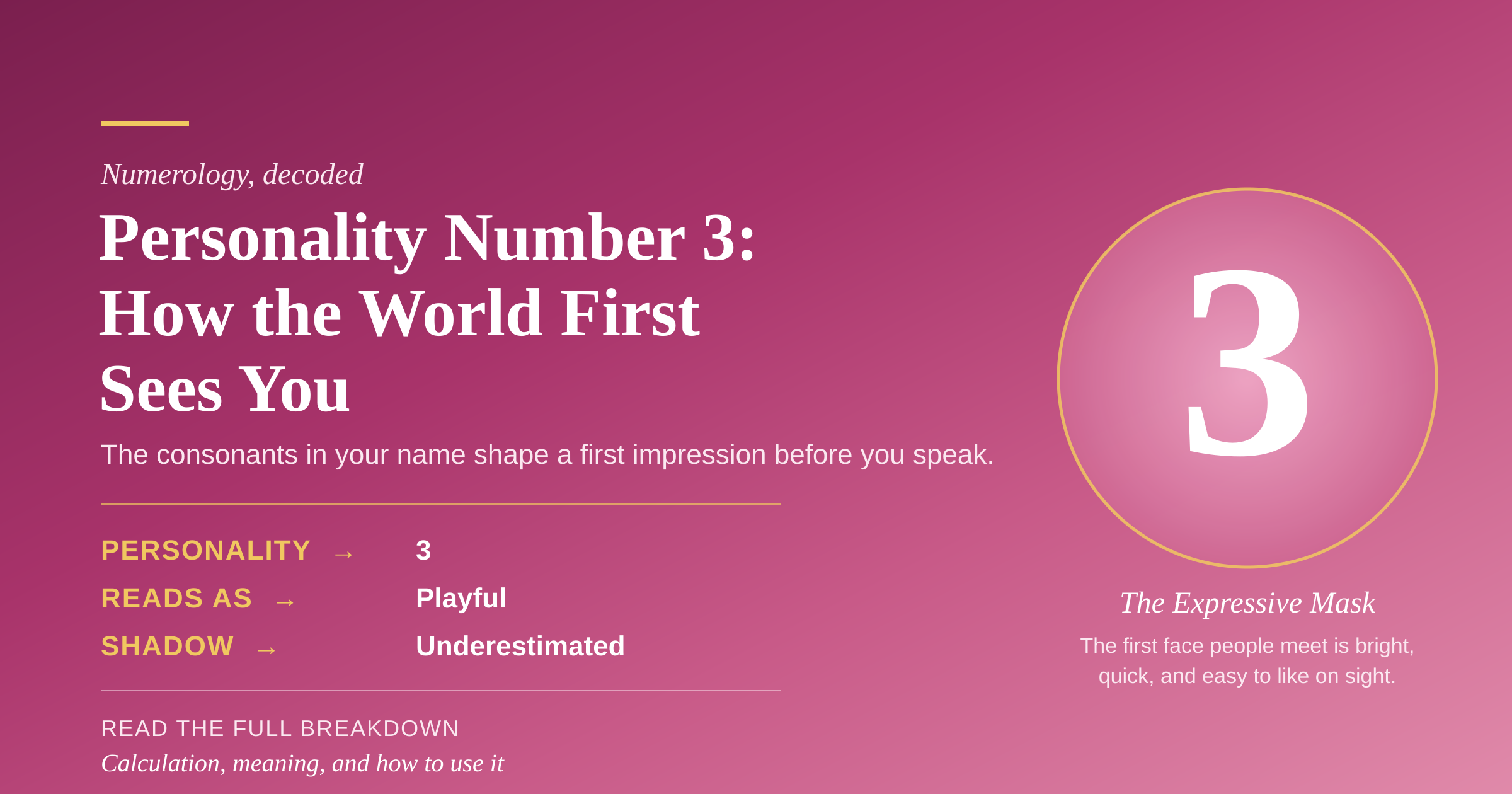
The consonants in your birth name build the mask people meet before they know anything real about you — and for Personality Number 3, that mask is bright, quick, and easy to like.
You walk into a room and something happens before you say a word. Someone's shoulders relax. A stranger laughs at something you haven't even finished saying. If you carry Personality Number 3, this happens to you more than you probably realize, and it is not an accident of charm — it is a pattern written into the consonants of your name.
Personality Number 3 is the numerology figure for a first impression that reads as animated, expressive, and fun. People decide within seconds that you are someone who makes things lighter. That is the gift. The complication is what that same lightness can hide.
Quick answer
Personality Number 3 means people read you as playful, witty, and expressive on first meeting — the room brightens when you walk in. The shadow side: that same charm can make people assume you are not entirely serious, so they underestimate the depth or reliability sitting underneath it.
What the Personality Number actually is
Numerology works with several different core numbers, and each one answers a different question about you. Your Life Path Number describes the overall shape of your journey. Your Soul Urge Number describes what you privately want. Your Destiny Number, built from every letter in your full name, describes your broader talents and life direction.
The Personality Number is narrower and, in a way, more immediate. It is built from only the consonants in your name — the vowels are stripped out entirely — and it describes the surface. This is the version of you that strangers, interviewers, first dates, and new coworkers encounter before they have earned access to anything deeper. Vowels, in the standard framework this article follows (the Decoz and Javane–Bunker tradition of Western Pythagorean numerology), are treated as carrying your inner life — your Soul Urge is calculated from them. Consonants carry the outer shell. Strip a name down to consonants only and you get a number for the shell alone.
Why this number matters even if you don't believe in fate
You don't have to treat numerology as prophecy to find the Personality Number useful. Treat it as a map of a pattern instead — a way of naming something you have probably already noticed about how people react to you, especially early on, before they have any other data. If you know your Personality Number is 3, you can stop being surprised that people assume you're carefree, or that they laugh along with you but hesitate to hand you something serious. You can plan around a real, observable dynamic instead of wondering why the same misread keeps happening in job interviews, first dates, and client meetings.
How Personality Number 3 is calculated
The method has five steps, and it only uses the consonants of your full name exactly as it appears on your birth certificate — first, middle, and last.
- Write out your full birth name: first, middle, last.
- Remove every vowel: A, E, I, O, U always go, and Y goes too whenever it makes a vowel sound in that name (W is almost always kept as a consonant, except in rare true vowel-pair sounds).
- Convert each remaining consonant to a number using the Pythagorean chart: 1 = J, S 2 = B, K, T 3 = C, L 4 = D, M, V 5 = N, W 6 = F, X 7 = G, P, Y 8 = H, Q, Z 9 = R.
- Add the consonant values within each name part separately — first name, middle name(s) together, last name — and reduce each subtotal to a single digit, unless that subtotal is already 11, 22, or 33, in which case you leave it as a Master Number.
- Add the three reduced totals together, then reduce that final sum to a single digit, again unless the sum itself lands on 11, 22, or 33.
Here is the full Pythagorean letter chart for reference, using consonants only:
| Value | Consonant letters |
|---|---|
| 1 | J, S |
| 2 | B, K, T |
| 3 | C, L |
| 4 | D, M, V |
| 5 | N, W |
| 6 | F, X |
| 7 | G, P, Y (consonant sound) |
| 8 | H, Q, Z |
| 9 | R |
Example — Michael Jeffrey Jordan
Rather than build an artificial name, it's worth working through a real, well-documented one. Basketball's Michael Jeffrey Jordan gives a clean, verifiable Personality Number 3, using his full legal name.
First name — MICHAEL: remove the vowels I, A, E. Consonants remaining: M, C, H, L.
M = 4, C = 3, H = 8, L = 3. Sum: 4 + 3 + 8 + 3 = 18. Reduce: 1 + 8 = 9.
Middle name — JEFFREY: remove the vowel E (twice). Y here makes a consonant sound, so it stays. Consonants remaining: J, F, F, R, Y.
J = 1, F = 6, F = 6, R = 9, Y = 7. Sum: 1 + 6 + 6 + 9 + 7 = 29. Reduce: 2 + 9 = 11 — this lands on a Master Number, so it is kept as 11, not reduced further.
Last name — JORDAN: remove the vowels O, A. Consonants remaining: J, R, D, N.
J = 1, R = 9, D = 4, N = 5. Sum: 1 + 9 + 4 + 5 = 19. Reduce: 1 + 9 = 10, then 1 + 0 = 1.
Final total: 9 (Michael) + 11 (Jeffrey) + 1 (Jordan) = 21. Reduce: 2 + 1 = 3.
Michael Jeffrey Jordan's Personality Number is 3 — and it tracks. Long before most people had ever seen him speak in an interview, they'd already decided from his smile and his ease on camera that this was someone electric and fun to watch, someone who made even a routine post-game press conference feel lighter. That is the Personality 3 signature: the surface reads as animated and quick long before anyone has assessed the substance underneath.
Michael Jeffrey Jordan's full birth name, reduced to consonants only, resolves to Personality Number 3.
If you'd rather not do this arithmetic by hand for your own name — including the judgment calls on Y and W — a Personality Number calculator handles the consonant extraction and the reduction rules for you.
Run your own full birth name through a verified calculator before you read further — the meaning below will land differently once you see your actual number.
Calculate your Personality NumberWhat Personality Number 3 means
People with Personality Number 3 tend to be read, almost instantly, as animated. Your face moves when you talk. Your energy is quick rather than measured. A stranger meeting you for five minutes at a party will often walk away describing you as "fun" before they can name a single fact about your actual life. There's a natural gift for making a room feel less stiff — humor arrives easily, warmth arrives easily, and people tend to relax around you faster than they do around most others.
This surface reading has real professional and social value. You put people at ease in first meetings. You're the one asked to lighten a tense negotiation, host the toast, break the ice in a group that's gone quiet. Whatever your actual profession, this Personality Number becomes a kind of social lubricant that most people would pay to have.
The shadow is the same trait viewed from underneath. Because the charm is so immediate, people can decide — often without meaning to — that you're not entirely serious. They laugh with you easily but hesitate before trusting you with something that requires weight: the big client, the difficult decision, the confession that needs to be taken seriously. The mask reads as lightness, and lightness gets mistaken for shallowness even when it isn't. If your inner numbers (Life Path, Destiny, Soul Urge) carry real depth, discipline, or gravity, Personality Number 3 can create a persistent, low-grade friction: people keep underestimating you at exactly the moments it costs you the most.
The gift
Instant warmth. People decide within seconds that you're safe, fun, and easy to be around — a real advantage in interviews, first dates, and any room that starts cold.
The shadow
Being underestimated. The same lightness that draws people in can make them slow to hand you responsibility, credit, or trust before they've seen your substance directly.
How to actually use this
The point of naming this pattern isn't to perform less charm — that would waste a genuine gift. It's to manage the gap between how you land in the first five minutes and what you actually need people to understand about you over time. In situations where you need to be taken seriously fast — a job interview for a role with real weight, a negotiation, a first meeting with someone who needs to trust your judgment — plan for the fact that your first impression may undersell you. Say the serious thing plainly, early, before the charm has had time to set the frame. Let the warmth do its job afterward, not instead of the substance.
It also helps to stop taking it personally when someone reads you as less weighty than you are on a first meeting. That reaction isn't a judgment of your character — it's a fairly literal response to the consonants in your name, filtered through a very old, very human habit of judging seriousness by tone and expression. Once you see it as a pattern instead of a verdict, it gets much easier to correct for it deliberately instead of quietly resenting it.
If you want to go further, compare your Personality Number against your Life Path and Destiny Numbers. A large gap between an animated Personality 3 and a heavier, more serious Life Path Number is common, and understanding that gap explains a lot of the "people don't get me at first" feeling that many Personality 3s carry. You can map both figures using the same numerology tools used for this calculation. For a deeper look at how the two forces interact, see our companion piece on [related article — add URL to Life Path vs Personality Number comparison].
Frequently asked questions
What is a Personality Number in numerology?
It's the number built from only the consonants in your full birth-certificate name. It describes the outer impression you make on people who don't know you well yet — the surface, not the whole picture.
How do you calculate Personality Number 3?
Take only the consonants from your first, middle, and last name. Convert each to a number using the Pythagorean chart, sum and reduce each name part separately (keeping Master Numbers 11, 22, 33 intact if they appear), then add the three totals and reduce the final sum the same way. You can check your own name with a Personality Number calculator to confirm the arithmetic.
Is Personality Number 3 a good number?
It carries a genuine gift — instant warmth and likability — alongside a real shadow: people can underestimate the depth or reliability sitting underneath the charm. Neither half is the whole story on its own.
What is the difference between Personality Number and Destiny Number?
The Destiny Number uses every letter in your name and reflects your broader talents and direction. The Personality Number uses consonants only and reflects the specific first impression you make before anyone knows you.
Does Y count as a vowel or consonant in this calculation?
It depends on the sound. When Y makes a vowel sound in a given name, it's excluded. When it makes a consonant sound — as in Jeffrey — it's included and valued at 7.
Can I change my Personality Number?
No — it's fixed to your birth-certificate name. A nickname or stage name doesn't change it, though many numerologists calculate a separate figure for an adopted public name to understand a chosen persona.
Why does my Personality Number feel different from how I actually feel inside?
That's expected — it's describing the mask other people meet first, not your internal experience. Your Soul Urge and Life Path Numbers are closer to how you experience yourself from the inside.
Takeaway: Personality Number 3 hands you an easy first impression — animated, quick, likable — but it also means people may need a second look before they see your depth. Naming that pattern lets you use the charm on purpose and make sure the substance still gets seen.