
Numerology, decoded
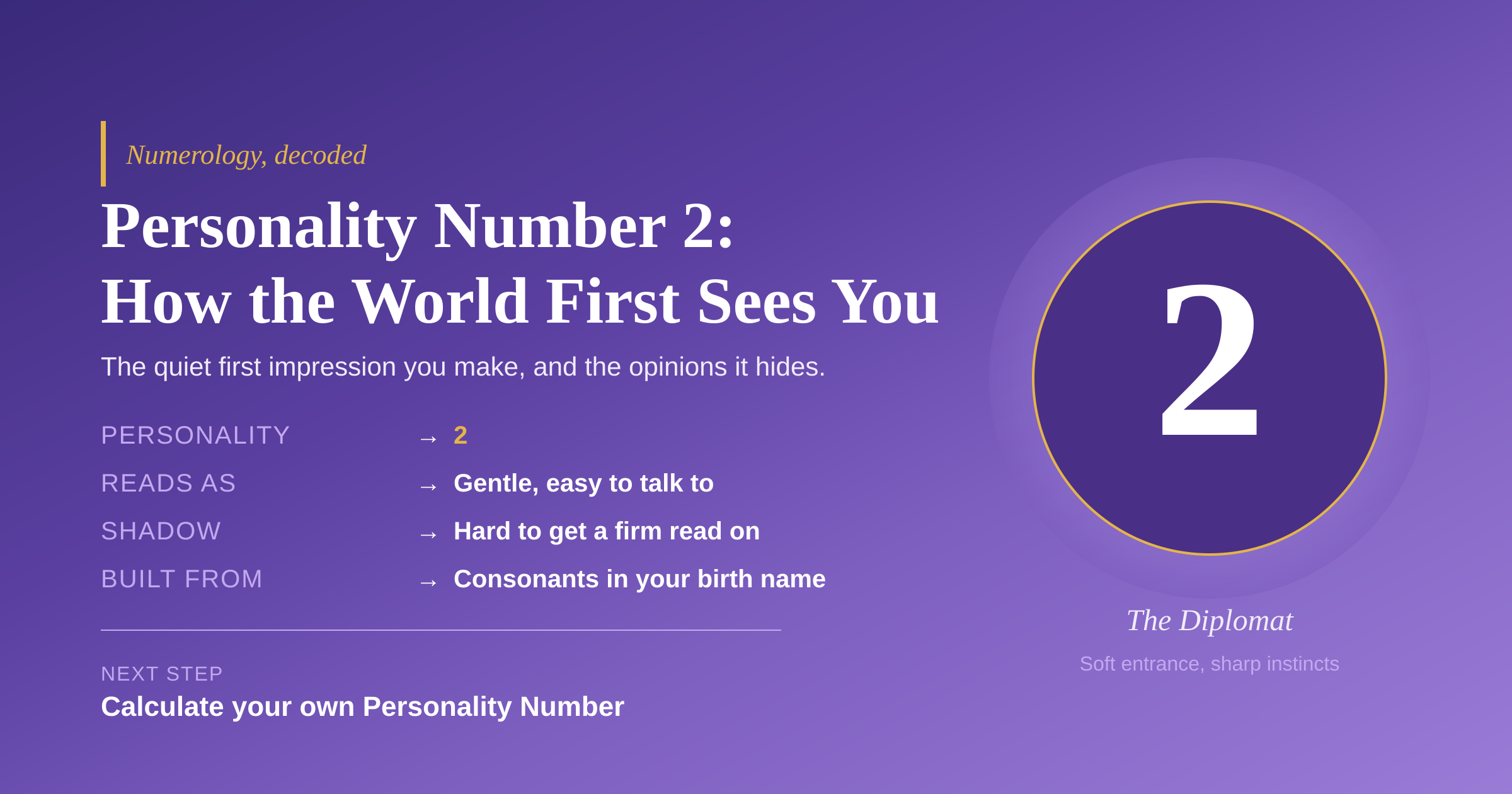
Personality Number 2: How the World First Sees You
The quiet first impression you make before anyone learns what you actually think.
You walk into a room and something about you makes people relax. They lean in a little. They start talking, and somewhere in the first few minutes they've told you more than they meant to. That's not an accident of mood — if your Personality Number is 2, it's a pattern that follows you everywhere, whether you're at a job interview, a first date, or standing in line at the pharmacy.
Quick answer: Personality Number 2 means people read you, on first contact, as gentle, approachable, and genuinely interested in what they have to say. The shadow side is that this softness can look like passivity — like you don't have strong opinions, when really you just haven't said them out loud yet.
What the Personality Number actually is
In Western numerology, your name carries several distinct numbers, and each one answers a different question. Your Life Path Number, drawn from your birthdate, describes the terrain you're walking. Your Expression Number, built from every letter in your full name, describes your capability and direction. The Personality Number asks something narrower and more immediate: what do people pick up about you before they know anything else?
It's calculated using only the consonants in your birth name — the vowels are stripped out entirely. The logic behind that is worth sitting with. Vowels, in this tradition, represent your inner life: what you want, what moves you, what you'd tell a close friend at 1am — that's closer to your Soul Urge Number. Consonants represent your outer shape — the version of you that shows up in a meeting, at a party, in a text message to someone you just met. The Personality Number is built purely from that outer shape, which is why numerologists treat it as a map of first impressions rather than a map of who you are underneath them.
Why this number matters more than it looks like it should
First impressions are stubborn. Research on person perception consistently finds that people form judgments within seconds and then spend the rest of the relationship filtering new information through that initial read. If your Personality Number is out of step with how you actually want to be perceived — say, you're ambitious and decisive but your Personality Number reads as soft and accommodating — you may notice a recurring gap between how capable you know you are and how quickly people take you seriously.
This isn't a flaw to fix. It's information. Knowing your Personality Number lets you decide, consciously, whether to lean into that first impression or actively counter it in the moments that matter — a negotiation, a pitch, a first date where you want your directness to show earlier than it naturally would.
How it's calculated — full worked example
The method uses the Pythagorean letter-number system, the same one behind most core numerology numbers:
| Value | Letters |
|---|---|
| 1 | A, J, S |
| 2 | B, K, T |
| 3 | C, L, U |
| 4 | D, M, V |
| 5 | E, N, W |
| 6 | F, O, X |
| 7 | G, P, Y |
| 8 | H, Q, Z |
| 9 | I, R |
Vowels — A, E, I, O, U — are always excluded. Y is excluded when it makes a vowel sound (as in "Kyle") and included as a consonant when it makes a consonant sound (as in "Yolanda"). W is almost always a consonant, with rare exceptions in true vowel-pair sounds. Everything else that isn't a vowel counts as a consonant, full stop.
You sum the consonant values within the first name and reduce to a single digit — unless that sum lands on 11, 22, or 33, a master number, which stays intact. You repeat that separately for the middle name and the last name. Then you add the three reduced totals together and reduce that final sum the same way, checking again for a master number before collapsing it to a single digit.
Example — Beyoncé Giselle Knowles
Beyoncé Giselle Knowles-Carter's documented birth name is Beyoncé Giselle Knowles (she added Knowles-Carter after marriage in 2008, so the birth-certificate calculation uses Knowles alone). Here's the arithmetic broken down consonant by consonant:
BEYONCE — consonants: B(2), Y(7), N(5), C(3). Sum: 2+7+5+3 = 17 → reduces to 1+7 = 8.
GISELLE — consonants: G(7), S(1), L(3), L(3). Sum: 7+1+3+3 = 14 → reduces to 1+4 = 5.
KNOWLES — consonants: K(2), N(5), W(5), L(3), S(1). Sum: 2+5+5+3+1 = 16 → reduces to 1+6 = 7.
Grand total: 8 + 5 + 7 = 20. Twenty is not a master number, so it reduces one more step: 2+0 = 2. Beyoncé's Personality Number is 2 — which tracks with a public persona widely described, especially early in her career, as warm, approachable, and easy to work alongside, even as her Expression and Life Path numbers point toward far more commanding, driven undertones underneath.
Beyoncé Giselle Knowles's consonants, name part by name part, reducing to Personality Number 2.
Run your own full birth name through the calculator instead of doing it by hand.
Open the Numerology ToolsWhat Personality Number 2 means day to day
People with a 2 Personality Number tend to get approached first. Strangers ask them for directions, coworkers vent to them in the break room, new acquaintances open up faster than they meant to. There's a natural softness in how a 2 personality holds a conversation — less talking, more listening, an instinct for making the other person feel like the room has slowed down just for them. This isn't performed warmth. It's closer to a genuine, almost reflexive curiosity about what makes other people tick.
The shadow of the number lives right next to the gift. Because a 2 personality reads as accommodating, people sometimes assume there's no strong opinion underneath — or worse, that agreement is being offered when it isn't. If you carry this number, you may have noticed that people are surprised when you finally state a firm boundary or a hard "no," as if it doesn't match the version of you they met first. That surprise is the tell: the softness of first contact was doing some unintentional camouflage work on your actual convictions.
None of this means the 2 personality is weak. Diplomats, mediators, and the best listeners in any room often carry this number, because peacemaking requires real strength — it's just strength that doesn't announce itself on arrival. The work, if this is your number, isn't to become someone else in first meetings. It's learning to let your actual opinions surface a little sooner than instinct wants them to. Run your own name through the personality number calculator to see exactly where you land before you decide what, if anything, to adjust.
How to use this number instead of just knowing it
Treat your Personality Number as a starting condition you're free to work with, not a verdict. If you're a 2 personality heading into a negotiation, a job interview, or a first date where you want to be taken seriously fast, build in a deliberate moment early on where you state something directly — a clear preference, a real opinion, a boundary — before the conversation settles into its natural, agreeable rhythm. That single early data point does a lot of work to recalibrate how the rest of the interaction gets read.
If you manage or mentor someone with this number, don't mistake their gentleness for a lack of position. Ask directly what they think, and give them a beat of silence to answer instead of filling it — the 2 personality often needs the space cleared before the real opinion comes out.
Compare this to your Expression Number and Life Path Number using the full numerology chart calculator — the gap between how you present and what actually drives you is often where the most useful self-knowledge sits. [related article — add URL: "Personality Number vs. Soul Urge Number: What's the Difference?"]
Frequently asked questions
What is a Personality Number in numerology?
It's a number calculated from only the consonants in your full birth name, describing the outer impression you make on people before they know you well — distinct from numbers that describe your inner drives or life direction.
How do you calculate the Personality Number?
Convert the consonants in your first, middle, and last birth names to their Pythagorean values, sum and reduce each name part separately, then add those three totals together and reduce the final sum — checking for master numbers 11, 22, and 33 at each stage.
What does Personality Number 2 mean?
It reads as gentle, warm, and easy to open up to. The shadow is that it can look passive or hard to pin down, because the softness can hide real opinions that haven't been voiced yet.
Is the Personality Number the same as the Destiny Number?
No. The Destiny (Expression) Number uses every letter in your name and describes your fuller potential. The Personality Number uses only consonants and describes the surface — your first impression, not your whole architecture.
Does a nickname change my Personality Number?
Standard practice uses your full birth-certificate name, not a nickname or a married name, since the number is meant to reflect the identity you were given at birth.
What happens if a name part reduces to 11, 22, or 33?
Master numbers stay intact rather than reducing further, both at the individual name-part stage and at the final combined total, because they're treated as carrying an intensified version of the base number's meaning.
Can two people share the same Personality Number?
Yes, very easily — many different names reduce to the same digit. The Personality Number describes a pattern of first impression rather than a unique fingerprint, so it's most useful read alongside your other core numbers. [related article — add URL: "The Five Core Numbers: How They Work Together"]
Takeaway: Personality Number 2 gives you an entrance that puts people at ease almost instantly — and a shadow that can make your real opinions harder to spot. Knowing which one is showing up in a given room is the whole advantage; use the numerology tools to check your own name against the calculation and see where you actually land.
If this resonates and you want the full system in one place, the book Sort Your Life by the Numbers: A practical introduction to the art of numbers walks through it step by step.